Estrogen Progesterone Testosterone Combination Therapy Guide
A woman in her early fifties may recognize this pattern immediately. Estrogen has quieted the hot flashes and night sweats, yet she still feels emotionally flat, tired, unfocused, and uninterested in sex. The partial improvement is welcome, but it raises a difficult question: would adding progesterone and testosterone create a more complete solution, or introduce risks that aren't worth taking?
The answer depends on anatomy, symptoms, timing, medical history, formulation, and the reason each hormone is being prescribed. An estrogen progesterone testosterone combination isn't a universal menopause formula. It is a targeted treatment approach that may fit some patients and make little sense for others. This guide explains how the hormones interact, what evidence supports, where safety concerns arise, and how Mississippi patients can discuss individualized care with a qualified provider.
Why Patients Ask About Three-Hormone Therapy
Partial relief creates complicated questions
Consider a patient who begins estrogen for disruptive vasomotor symptoms. Her sleep improves because she no longer wakes soaked in sweat. Her daytime hot flashes become manageable, and vaginal discomfort may ease. Yet her motivation remains low, her concentration feels unreliable, and sexual desire hasn't returned.
That experience doesn't automatically mean she needs testosterone. It may reflect poor sleep, depression, relationship stress, medication effects, thyroid disease, anemia, pain with intercourse, or the normal complexity of menopause. A thoughtful evaluation looks beyond a single hormone level and asks what changed, what didn't, and what other conditions could explain the remaining symptoms.
Patients also ask about progesterone because they hear the word “balance” used loosely. Progesterone isn't just an ingredient added to make estrogen feel more natural. For a woman who still has a uterus, a progestogen generally serves a specific protective purpose when systemic estrogen is prescribed. The treatment decision is medical, not cosmetic.
A useful starting point: Every hormone in a regimen should have a defined job, a reasonable dose, and a plan for reassessment.
The three-hormone question
The classic menopausal hormone therapy approach for a woman with a uterus is estrogen plus progestogen. Testosterone is different. Current guidance identifies persistent low sexual desire after other causes have been assessed as the evidence-based indication for systemic testosterone in postmenopausal women, rather than fatigue, brain fog, or general wellness alone. The National Center for Biotechnology Information review of menopausal hormone therapy describes this protective role for progestogen and the narrow indication for testosterone.
That distinction matters because the symptoms overlap. Low desire can occur alongside poor sleep, hot flashes, vaginal pain, mood changes, or relationship concerns. Adding a third hormone before investigating those factors can make treatment more complicated without addressing the actual cause.
Mississippi patients in Oxford, Meridian, Tupelo, Flowood-Jackson, Starkville, and surrounding communities deserve a conversation that separates symptom relief from hormone marketing. A provider-led assessment can determine whether two hormones are enough, whether testosterone has a legitimate role, or whether a nonhormonal treatment would be safer and more appropriate.
What Each Hormone Does and Why They Are Combined
Think of the reproductive hormones as an orchestra rather than three separate prescriptions. Estrogen is the lead instrument , progesterone provides the protective counterbalance, and testosterone may contribute a quieter performance role when a specific indication exists. The goal isn't to make every instrument louder. The goal is to produce the right result without allowing one section to overpower the rest.

Estrogen sets the main rhythm
Estrogen can relieve vasomotor symptoms such as hot flashes and night sweats. It also supports vaginal and urinary tissues and contributes to bone physiology. For many patients, these are the symptoms that prompt the first discussion about hormone replacement therapy , or HRT.
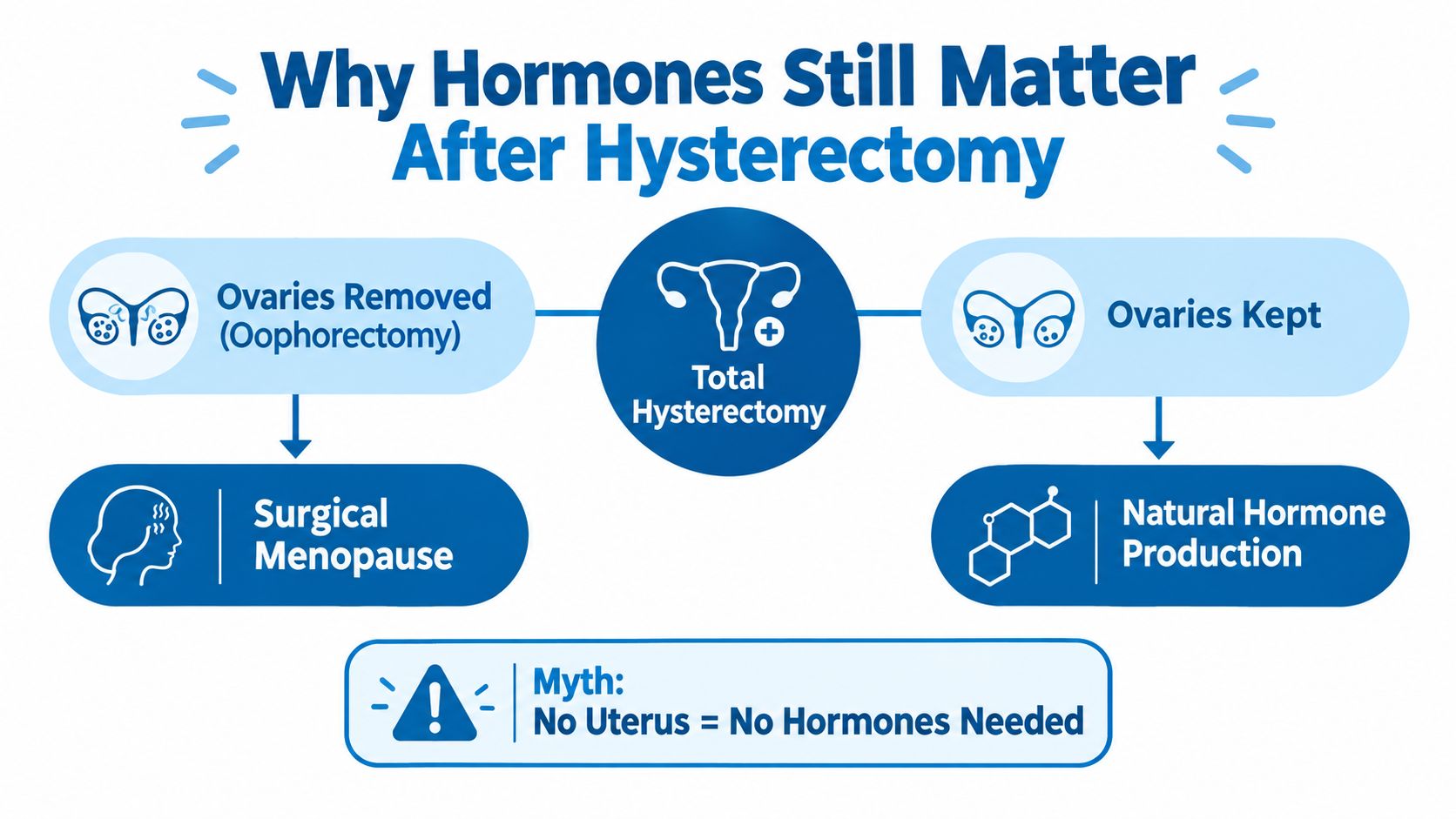
Estrogen alone may be appropriate for a patient who has had a hysterectomy, depending on her clinical circumstances. But a woman with an intact uterus generally needs endometrial protection when she uses systemic estrogen. Estrogen stimulates the endometrium, the lining of the uterus. Without adequate opposition, that stimulation can cause hyperplasia and increase malignancy risk.
Progesterone protects the uterus
A progestogen is added to reduce the risk of estrogen-driven endometrial overgrowth. The regimen may be continuous or cyclic, depending on the patient's situation and the clinician's plan. Micronized progesterone is one formulation clinicians may consider, but route, dose, timing, and the amount of estrogen all matter.
Progesterone can also affect bleeding patterns, breast symptoms, sleep, and mood. Those effects vary between patients, so “progesterone protection” doesn't mean every formulation will feel identical.
For a plain-language explanation of the first two hormones, see Pause Medical's guide to estrogen and progesterone.
Testosterone has a narrower role
Women produce testosterone, but adding it to menopausal therapy isn't automatically appropriate when a patient feels tired or mentally foggy. The strongest evidence supports considering systemic testosterone for postmenopausal women with hypoactive sexual desire disorder , after medical, psychological, relationship, and medication-related causes have been considered.
That makes the full three-hormone regimen different from a routine estrogen-plus-progestogen plan. A clinician should be able to explain why testosterone is being added, what outcome will be measured, and what would prompt dose reduction or discontinuation.
Evidence-Backed Benefits of Each Hormone in the Mix
A patient may notice fewer hot flashes after starting estrogen, sleep better once night sweats settle, and still need progesterone because the uterus requires endometrial protection. Testosterone belongs to a narrower part of that plan. The three hormones do not provide interchangeable benefits, and adding all three should reflect a defined clinical goal.

What estrogen can realistically provide
Estrogen has the clearest evidence for reducing hot flashes and night sweats. It may also relieve vaginal dryness and support bone health. Follow-up findings from the Women's Health Initiative describe lower diabetes and fracture risk with menopausal hormone therapy, while showing that cardiovascular and cancer tradeoffs vary with timing and patient characteristics. The WHI follow-up publication reports a more favorable balance for some patients who start before age 60 or within 10 years of menopause than for those who begin much later.
For a broader, patient-friendly summary, see Pause Medical's overview of HRT benefits for women.
Hormone therapy has not shown a general mental-health benefit. The Women's Health Initiative hormone-therapy component enrolled 16,608 women , and combined therapy did not significantly improve mental health or depressive symptoms at one year. A separate follow-up involving 1,511 participants also found no significant mental-health benefit at three years, as summarized in the Cambridge review of transdermal estradiol and testosterone therapy.
Patients can still feel emotionally better when treatment reduces night sweats, pain, and temperature disruption. The improvement may come from restored sleep and daily function, rather than a direct treatment effect on depression.
Why testosterone evidence is more specific
Testosterone added to an estrogen-based regimen may improve desire, arousal, and sexual enjoyment for menopausal women with an appropriate clinical indication. The evidence supports targeted treatment, not general “optimization” for fatigue, weight gain, brain fog, or every change associated with menopause.
A careful assessment asks:
- Desire: Has sexual interest stayed persistently low?
- Distress: Does the change cause personal distress?
- Alternative causes: Have pain, medications, mood, sleep, relationship factors, and medical conditions been reviewed?
- Treatment target: Can the patient and clinician describe the expected improvement?
Testosterone makes sense only when the problem, goal, and follow-up measures are clear. Without that structure, the rationale for a three-hormone regimen becomes difficult to assess.
Understanding the Real Risks and Safety Tradeoffs
The word bioidentical describes molecular structure, not automatic safety. A bioidentical hormone can still stimulate tissue, affect bleeding, alter clot risk, or contribute to cancer risk. Compounded products also require careful attention to consistency, documentation, and monitoring. The patient's risk profile depends on the hormone, route, dose, duration, age, time since menopause, and medical history.
Testosterone doesn't cancel estrogen risk
A common assumption is that testosterone counterbalances estrogen in breast or uterine tissue. Available evidence doesn't support treating testosterone as a protective antidote. In postmenopausal endometrium, adding testosterone to estrogen changes sex-hormone receptor expression. Short-term estrogen, progesterone, and testosterone studies found no major reduction in breast or endometrial proliferation.
One observational analysis reported about a 77% higher invasive breast-cancer risk among current users of estrogen-plus-testosterone compared with never-users of postmenopausal hormone therapy. The published breast-cancer analysis provides the source for that estimate. Observational findings can't determine that the combination caused every event, but they do reinforce the need for a careful indication and ongoing review.
Long-term combined estrogen-progestogen use has also been associated with increased breast cancer risk, while some reviews note that endometrial and breast cancer risk can rise by up to 10% per year of use in certain long-term contexts, as summarized in the NCBI clinical review. That figure shouldn't be applied mechanically to every formulation or patient. It illustrates why duration matters.
Regimen and duration change the conversation
| Regimen | Endometrial consideration | Key risk signal | Best-fit patient |
|---|---|---|---|
| Estrogen alone | Generally unsuitable for a woman with a uterus unless a clinician has a specific protective plan | Risk from unopposed endometrial stimulation | Some patients without a uterus, after individualized review |
| Estrogen plus progestogen | Progestogen protects against estrogen-driven endometrial hyperplasia | Long-term combined use can increase breast-cancer risk | A woman with a uterus who has a clear indication for systemic estrogen |
| Estrogen plus progesterone plus testosterone | Testosterone doesn't reliably reduce breast or endometrial proliferation | Breast-cancer risk and androgen-related adverse effects require review | Selected postmenopausal women with persistent low desire after assessment |
| Any systemic regimen started later in life | Requires especially cautious cardiovascular and cognitive risk review | Starting at age 65 or later is associated with higher coronary event, stroke, and dementia risk in WHI follow-up | Only when a clinician identifies a compelling, individualized reason |
The 2022 U.S. Preventive Services Task Force recommendation and WHI evidence state that menopausal hormone therapy shouldn't be used for primary prevention of chronic conditions. Oral therapy increased stroke and blood-clot risk, didn't prevent heart attacks, and combined estrogen-plus-progestin therapy increased breast cancer risk over time, according to the WHI summary of the FDA HRT warning.
For a patient-specific discussion, review Pause Medical's explanation of hormone therapy risks and benefits.
Medical disclaimer: This article is for education, not diagnosis or individualized treatment. Hormone therapy can be inappropriate or unsafe for some people. Don't start, stop, or change estrogen, progesterone, testosterone, or any other prescription without discussing it with a qualified clinician.
Dosing Routes and Formulation Considerations
The route of delivery isn't a minor preference. It can change how the body processes estrogen and how clinicians think about clot risk, bleeding, tolerability, and adherence.
Estrogen route affects risk assessment
Oral estrogen passes through the liver before reaching systemic circulation. That first-pass effect can influence clotting factors and triglycerides. Transdermal estrogen, delivered through a patch, gel, or another skin-based system, bypasses first-pass liver metabolism and is generally preferred for people with higher venous thromboembolism risk when systemic estrogen is otherwise appropriate.
That doesn't make transdermal treatment risk-free. A clinician still reviews prior clots, thrombophilia, body weight, smoking, migraine history, cardiovascular disease, blood pressure, and other relevant factors. The dose also matters.
Practical rule: The safest route is the route that matches the patient's medical risks and can be used consistently, not the route that sounds most “natural.”
Formulation choices should answer clinical questions
| Treatment choice | Practical advantage | Important limitation |
|---|---|---|
| Oral estrogen | Convenient tablet administration | Greater hepatic exposure and clotting considerations |
| Transdermal estrogen | Avoids first-pass liver metabolism | Still requires individualized screening and monitoring |
| Micronized progesterone | A commonly considered progestogen option | May affect sleep, mood, bleeding, and tolerability |
| Local vaginal estrogen | Targets genitourinary symptoms | Doesn't replace systemic treatment when whole-body symptom control is needed |
| Transdermal testosterone | Allows cautious, adjustable exposure | Requires precise dosing and blood-level monitoring |
Endometrial protection must be proportionate to the estrogen dose. Increasing estrogen without revisiting the progestogen plan can leave the uterus inadequately protected. Unexpected bleeding deserves evaluation rather than an automatic dose increase.
Female testosterone therapy also needs special care. In the United States, clinicians may use products designed for men in carefully adjusted, off-label amounts, or prescribe compounded preparations when clinically appropriate. The goal is to maintain female-appropriate blood levels, not to reproduce male dosing.
This is why the distinction between bioidentical hormones and synthetic hormones should be discussed with a clinician in terms of evidence, route, quality, and monitoring rather than branding alone.
The following video offers general background on hormone delivery and should supplement, not replace, a medical consultation.
Monitoring Interactions and Contraindications
Safe care is a continuing process, not a prescription written once and forgotten. Before treatment, a clinician should establish the symptom pattern, medical history, reproductive anatomy, cancer history, clotting history, medications, cardiovascular risks, and treatment goals. Testosterone deserves an especially careful biopsychosocial assessment because low desire often has more than one cause.

What clinicians evaluate before starting
A baseline review may include:
- Symptoms and goals: Hot flashes, sleep disruption, vaginal symptoms, mood, desire, energy, and the degree of distress.
- Anatomy: Whether the patient has a uterus determines the need for endometrial protection with systemic estrogen.
- Bleeding: Undiagnosed vaginal bleeding requires evaluation before therapy begins.
- Cancer history: A history of hormone-sensitive cancer may change or prevent treatment choices.
- Clot and cardiovascular risk: Prior thrombosis, thrombophilia, stroke, uncontrolled hypertension, and other risks influence route and eligibility.
- Medication interactions: Patients should disclose anticoagulants, seizure medicines, thyroid replacement, antidepressants, supplements, and every nonprescription product.
Blood work may help evaluate testosterone, lipids, liver function, thyroid status, blood counts, or other conditions that mimic hormone-related symptoms. A hormone result is one piece of the assessment, not a standalone diagnosis.
Follow-up keeps each hormone accountable
After starting treatment, the provider reviews symptoms, adverse effects, bleeding, blood pressure, physical changes, and adherence. Testosterone follow-up includes laboratory testing to keep levels within an appropriate range and questions about acne, unwanted hair growth, scalp hair changes, voice changes, mood, and sexual response.
A patient should report new or persistent vaginal bleeding, breast changes, severe headaches, chest pain, shortness of breath, unilateral leg swelling, or neurologic symptoms promptly. These symptoms can have many causes, but they warrant medical attention rather than self-adjustment.
For patients who want help understanding laboratory language, Pause Medical's guide to reading hormone blood test results can provide general context. The treating clinician must interpret results alongside symptoms, timing, medications, and the specific formulation used.
The most useful question at every review is simple: Is each hormone still earning its place? If estrogen controls vasomotor symptoms but testosterone produces no meaningful sexual benefit, the regimen deserves reconsideration. If progesterone causes intolerable effects, the clinician may explore a different protective strategy rather than abandoning uterine safety.
Frequently Asked Questions and Next Steps
Are bioidentical hormones safer than other hormones?
Not automatically. “Bioidentical” means the hormone has a structure identical or closely matching a hormone produced by the body. Safety still depends on indication, route, dose, duration, product quality, monitoring, and personal risk factors. A bioidentical estrogen-progesterone-testosterone combination can still affect breast tissue, the endometrium, bleeding, and clot risk.
Is testosterone safe for women long-term?
Long-term safety remains more limited than short-term evidence for selected sexual-function benefits. Current guidance supports systemic testosterone for postmenopausal women with persistent low sexual desire after other causes have been assessed. It doesn't support routine use for nonspecific fatigue, brain fog, or general anti-aging goals. Regular clinical and laboratory reassessment is essential.
Can the combination help with weight or energy?
It shouldn't be presented as a primary weight-loss treatment. Hormone therapy may improve symptoms that interfere with sleep, movement, or daily functioning, but that isn't the same as directly treating obesity. In the STEP 1 semaglutide trial, 86.4% of participants receiving semaglutide 2.4 mg achieved at least 5% weight loss by week 68, compared with 31.5% receiving placebo, and participants who remained on treatment for the full 68 weeks lost an average of 17.4% of body weight , according to the trial results summary. Medical weight loss requires its own evaluation.
How do I know when to stop or adjust?
Adjustments follow symptoms, side effects, examination findings, and laboratory results. New bleeding, androgenic changes, breast symptoms, clot symptoms, or lack of meaningful benefit should prompt a review. Don't stop prescribed hormones abruptly or change the dose without guidance.
The right framework is the right hormone, route, dose, duration, and patient . Readers who want broader career context while researching endocrine care can also browse no-call endocrinology openings, a resource for understanding where endocrinology professionals work and how clinical practices are staffed.
Mississippi adults considering HRT can schedule a consultation with a Pause Medical provider to review symptoms, anatomy, personal risks, treatment goals, and whether testosterone has a legitimate role. This type of conversation is more useful than choosing a three-hormone formula based on a symptom checklist alone.
Pause Medical offers clinician-guided hormone replacement therapy, medication management, and medically supervised weight-loss care for Mississippi patients, with individualized evaluation and follow-up. Visit Pause Medical to schedule a consultation and discuss whether an estrogen, progesterone, or testosterone treatment plan fits your health needs.