What Hormones Change During Menopause and Why
You wake at 3 a.m. with night sweats, even though your periods still arrive. A few weeks later, you skip a cycle, lose your train of thought during a meeting, and wonder whether stress, thyroid disease, or aging is responsible. This pattern is common during the menopausal transition, but it doesn't come from one hormone suddenly switching off.
Menopause involves a coordinated change in ovarian hormones and pituitary signals . Estradiol, estrone, progesterone, follicle-stimulating hormone, luteinizing hormone, testosterone, inhibin B, and AMH each follow a different path. Understanding that map makes symptoms and laboratory results easier to interpret.
The Hormone Cast Behind Your Menopause Symptoms
A 47-year-old can have regular periods and still be in an early stage of perimenopause. Her ovaries may release an egg inconsistently, progesterone may be lower in some cycles, and estrogen may swing rather than decline smoothly. The result can be a night of sweating, restless sleep, irritability, or brain fog before her menstrual pattern changes clearly.
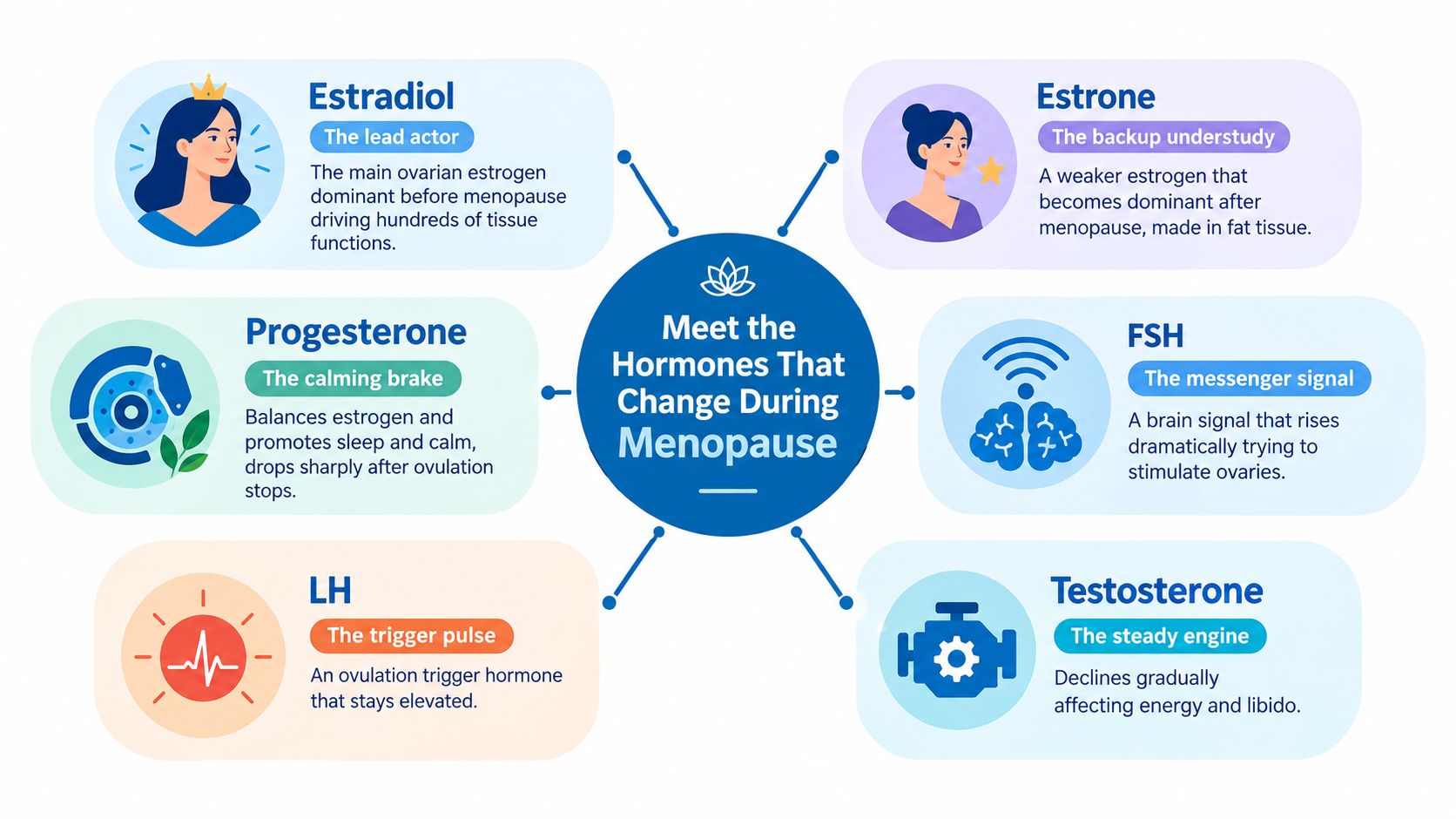
That's why menopause shouldn't be described as a single estrogen drop. It's better understood as a changing cast:
- Estradiol is the strongest and most active estrogen before menopause. It affects reproductive tissues, bones, blood vessels, skin, and the brain.
- Estrone is a weaker estrogen that becomes more important after ovarian estradiol production falls.
- Progesterone rises after ovulation and helps regulate the uterine lining, sleep, and nervous-system calm.
- FSH and LH are pituitary messengers. They signal the ovaries to develop follicles, produce hormones, and support ovulation.
- Testosterone comes from the ovaries and adrenal glands. It contributes to sexual desire, muscle function, energy, and motivation.
- Inhibin B and AMH reflect activity within ovarian follicles. Their decline can begin before obvious menstrual changes.
The phrase estrogen-progesterone imbalance can be useful when discussing symptoms, but it shouldn't imply that one universal ratio explains every person's experience. The estrogen progesterone imbalance resource from The Axelrad Clinic offers additional context, though diagnosis still requires a clinician to consider symptoms, periods, medications, and other health conditions together.
Why the timing matters
The same symptom can have different hormonal explanations depending on the phase. Hot flashes during late perimenopause may reflect rapid estradiol withdrawal, while sleep disruption earlier in the transition may be more closely related to inconsistent ovulation and reduced progesterone. After menopause, the pattern becomes steadier, with persistently low ovarian steroid production and higher pituitary signals.
A blood test captures one moment. Your symptoms may reflect weeks or months of changing signals. The practical question isn't, “Is my estrogen low?” It's, “Which part of the hormone system is changing, and does that match what I'm experiencing?”
Meet the Hormones That Change
Think of the endocrine system as a communication loop. The brain and pituitary send instructions, the ovaries respond, and ovarian hormones report back to the brain. As ovarian follicle activity declines, the feedback signal weakens, so the pituitary increases its messages.
Estradiol and estrone
Estradiol is the lead estrogen before menopause. The ovaries produce most of it, and it supports many tissues, including the uterus, vagina, bones, skin, brain, and cardiovascular system. Its effects are broad, which helps explain why changing estradiol can produce symptoms in several body systems at once.
Estrone is a weaker estrogen. After menopause, the body makes more estrone through conversion in fat and adrenal-related tissues, so it becomes the main circulating estrogen even though total estrogen activity remains much lower than before menopause.
Progesterone
Progesterone is the cycle's calming counterweight . After ovulation, it prepares the uterine lining and interacts with brain pathways involved in relaxation and sleep. When ovulation becomes less reliable, progesterone production can fall before estrogen becomes consistently low. That may create shorter cycles, stronger premenstrual-type symptoms, breast tenderness, irritability, or difficulty sleeping.
For readers seeking more discussion of progesterone symptoms, a Shawnee clinic resource for progesterone concerns can provide general educational background. It shouldn't replace an individualized evaluation.
FSH, LH, and the supporting players
FSH is the pituitary's follicle-stimulating message. As inhibin B and ovarian feedback decline, FSH rises and tries to recruit follicles more forcefully. LH helps trigger ovulation and also rises after menopause as ovarian feedback fades.
Testosterone isn't exclusively a male hormone. Ovaries and adrenal glands produce it in women, and it contributes to libido, muscle maintenance, energy, and drive. It typically changes more gradually than estradiol.
Inhibin B and AMH come from ovarian follicles. Inhibin B normally restrains FSH, while AMH reflects the pool of follicles that remain responsive. Both decline as follicle activity diminishes, although neither is a stand-alone confirmation test for menopause.
For a visual explanation of the two central ovarian hormones, see Pause Medical's explanation of estrogen and progesterone.
When Each Hormone Shifts Across the Transition
Hormone changes begin before the final menstrual period, so symptoms do not map neatly to one sudden estrogen drop. Early in the transition, declining follicle activity usually lowers inhibin B and AMH. With less ovarian feedback reaching the pituitary, FSH starts to rise. These markers help describe ovarian function, but they do not confirm menopause on their own.
FSH is often the first clearly measurable signal. Prospective endocrine data found that FSH typically begins rising about 6.1 years before the final menstrual period , accelerates around 2.05 years before it , and reaches a stable plateau about 2 years afterward . Estradiol may still fluctuate during this period, which explains why a high or low result does not always match how you feel.
The final menstrual period as a reference point
Estradiol follows a later, less orderly path. It can remain relatively preserved through much of perimenopause, then decline more rapidly beginning roughly 2 years before the final menstrual period and stabilize around 2 years afterward ( review of hormonal patterns). Around the final menstrual period, the overall pattern is a transition from variable ovarian output to consistently lower estrogen production.
Progesterone often becomes inconsistent earlier in practical terms because ovulation is no longer reliable. A period can still occur without a strong post-ovulation progesterone rise. Estradiol may also swing high and low, making perimenopause feel more turbulent than the steadier postmenopausal phase.
Testosterone generally drifts down more gradually than estradiol. LH also rises as ovarian feedback weakens, although its timing and clinical usefulness differ from FSH. In other words, the hormone driving symptoms depends partly on the phase: progesterone becomes erratic when ovulation falters, estradiol becomes more variable during perimenopause, and persistently low estradiol becomes more characteristic after the final menstrual period.
A Pause Medical perimenopause guide offers further background for placing menstrual changes and hormone patterns in context.
Practical rule: A changing symptom pattern and menstrual history may tell your clinician more about perimenopause than a single hormone result.
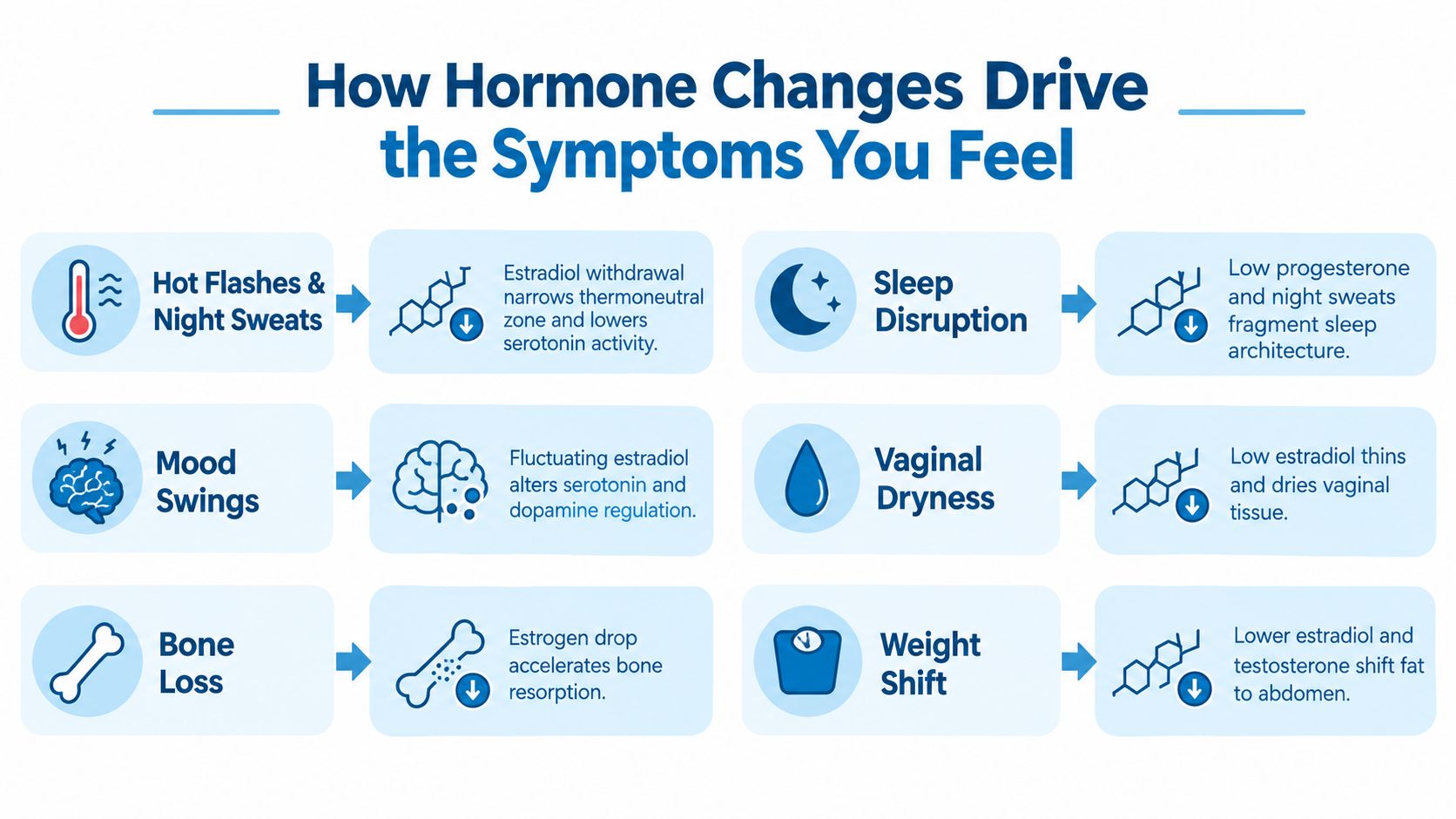
How Hormone Changes Drive the Symptoms You Feel
Symptoms don't always match the final hormone level. During perimenopause, volatility can be more disruptive than a stable low level because the brain, blood vessels, reproductive tissues, and sleep system must repeatedly adjust.
- Hot flashes and night sweats: Rapid estradiol withdrawal can alter temperature regulation and serotonin-related signaling. The brain's temperature-control range becomes less forgiving, so a small internal change can trigger sweating or flushing.
- Sleep disruption: Lower progesterone removes some of its calming influence, while night sweats interrupt sleep. A person may feel exhausted but still wake repeatedly.
- Brain fog: Fluctuating estradiol can affect hippocampal and prefrontal networks involved in attention, memory, and word retrieval. That doesn't mean cognitive decline is inevitable. It means mental performance may feel less consistent during hormonal swings.
- Mood changes and anxiety: Estradiol fluctuations and progesterone withdrawal can influence serotonin, dopamine, and calming pathways. Mood symptoms deserve their own evaluation because depression, anxiety disorders, thyroid disease, and medication effects can overlap.
- Vaginal and urinary symptoms: Chronic low estradiol, along with lower androgen support, can affect vulvovaginal and bladder tissues. Dryness, burning, painful sex, urinary urgency, and recurrent discomfort may persist after hot flashes improve.
- Skin and joint changes: Estradiol supports collagen and connective-tissue maintenance. Its decline may contribute to drier skin, altered skin elasticity, and joint stiffness. A practical overview of what changes during menopause skincare can help with topical care, while persistent joint symptoms need medical assessment.
- Weight redistribution: Lower estradiol and changing androgen balance can shift fat storage toward the abdomen. Sleep loss, reduced activity, thyroid disease, insulin resistance, and medications may also contribute.
- Lower libido: Desire can be affected by estradiol and testosterone changes, vaginal discomfort, sleep loss, relationship stress, mood, and medication effects. No single hormone explains every libido concern.
This video offers another patient-friendly way to connect hormonal changes with menopause symptoms.
For a focused discussion of estrogen-related symptoms and treatment questions, see Pause Medical's guide to low estrogen.
Typical Lab Patterns in Perimenopause and Postmenopause
A blood test during perimenopause can look different from one taken a few weeks later. Ovarian activity is uneven, so estradiol may be low on one draw and higher on another. FSH can also rise on some days and appear less high on others. That variation fits a transition in progress, rather than disproving perimenopause.
After the final menstrual period, the pattern usually settles. Ovarian steroid and peptide production remains very low, while pituitary gonadotropins stay high. Estradiol may fall by roughly 90% across the 3 to 4 years surrounding the final menses , and about half of the eventual postmenopausal FSH rise is already present at the final menstrual period ( hormone review).
| Hormone | Perimenopause | Postmenopause, 1 to 5 years | Postmenopause, 5+ years |
|---|---|---|---|
| Estradiol | Fluctuating, sometimes still preserved | Low and becoming more stable | Low; one comparison found a mean of 21.4 pg/mL |
| Estrone | Variable, gradually more prominent | Main circulating estrogen | Main circulating estrogen |
| Progesterone | Often low or absent when ovulation doesn't occur | Persistently low | Persistently low |
| FSH | Variable and progressively higher | Elevated | One comparison found a mean of 68.7 mIU/mL |
| LH | Variable, then rising | Elevated | Elevated |
| Inhibin B | Declining, may become nearly absent | Very low or undetectable | Very low or undetectable |
| AMH | Declining with follicle activity | Very low or undetectable | Very low or undetectable |
| Testosterone | Gradual change | Lower than reproductive levels, not absent | Lower than reproductive levels, not absent |
FSH commonly exceeds 30 mIU/mL , while estradiol below 20 pg/mL supports menopause. These values are clues, not a stand-alone verdict. Menstrual history, symptoms, age, and clinical context determine how a clinician reads them. Hormonal contraception can obscure the natural pattern, and a single day-3 FSH cannot reliably confirm or exclude perimenopause. The Pause Medical guide to reading hormone blood test results explains why clinicians compare hormone values with timing and symptoms instead of treating one result as the whole picture.
What the Hormone Map Means for HRT Decisions
A hot flash during late perimenopause does not automatically point to one low hormone value. Treatment decisions follow the phase-specific pattern: fluctuating estradiol and progesterone during the transition, then persistently low ovarian hormones after menopause. Clinicians consider symptom burden, menstrual and menopause timing, age, uterus status, cardiovascular and breast cancer risk, clot history, migraine, liver disease, and personal preferences rather than pursuing a target laboratory result.
For someone with a uterus, systemic estrogen is generally paired with a progestogen to protect the uterine lining. Transdermal estradiol, delivered through a patch or gel, avoids first-pass liver processing. Micronized progesterone is one option clinicians may consider. After hysterectomy, estrogen alone may be appropriate, depending on the surgery and medical history.
Local vaginal estrogen serves a different map of symptoms. It acts mainly on vaginal tissue and may help dryness, burning, painful sex, or urinary discomfort. Cancer history and other risks still require review before prescribing.
Hormone therapy should match the symptom pattern and the person's risks, not a marketing promise or a single blood draw.
Timing and route require individual review
For appropriate candidates, starting systemic hormone therapy under 60 or within 10 years of menopause may lead to a more favorable cardiovascular risk-benefit discussion. This timing hypothesis is not a universal prescription. The route also matters when clinicians assess clot risk, blood pressure, migraine, smoking, and related conditions.
Testosterone is not a routine treatment for fatigue, weight gain, or low motivation. A clinician may consider it for carefully evaluated hypoactive sexual desire symptoms after other contributors are addressed, with monitoring for adverse effects.
Bioidentical hormones require a precise definition. FDA-approved products may share the molecular structure of hormones made in the body while providing standardized dosing, purity controls, and regulated labeling. Evidence remains insufficient to determine the safety and effectiveness of compounded estriol compared with FDA-approved bioidentical products, and well-designed controlled studies do not support most marketing claims for compounded bioidentical hormone therapy.
A structured menopause HRT guide from Pause Medical can help patients prepare questions for a qualified prescribing clinician.
Clearing Up Common Misconceptions About Menopause Hormones
A person can wake after several hot flashes, see an estradiol result within the laboratory range, and wonder whether menopause is really involved. The answer depends on timing. Menopause is a sequence of shifting signals, not a single estrogen event.
Progesterone often becomes less predictable first as ovulation occurs less consistently. Estradiol may then swing sharply before reaching a lower postmenopausal level. In response, the pituitary releases more FSH, and often more LH, to stimulate ovaries that respond less reliably. A single blood test captures one moment in that changing sequence.
| Common belief | What the evidence shows |
|---|---|
| Menopause is only an estrogen deficiency | Ovarian steroid and peptide hormones change, while FSH and LH rise. |
| A single hormone test can confirm perimenopause | Cycle history, symptoms, medications, and patterns over time often provide more useful context. |
| Testosterone is only a male hormone | Women produce testosterone, which contributes to sexual desire, muscle function, energy, and motivation. |
| Compounded bioidentical hormones are automatically safer | Evidence does not show that compounded products are safer or more effective than approved options. Standardized, regulated products have more consistent dosing and labeling. |
| Saliva or urine testing gives the complete answer | Results can vary with collection conditions and treatment timing. A clinician should decide whether serum testing adds useful information and interpret it alongside symptoms. |
| Every symptom is caused by menopause | Thyroid disease, anemia, depression, sleep disorders, medication effects, and other conditions can overlap with menopause symptoms. |
A normal estradiol result does not invalidate night sweats, disrupted sleep, anxiety, or concentration problems. During perimenopause, levels can rise and fall quickly. After menopause, persistently low local estrogen activity may better explain ongoing vaginal symptoms than a temporary blood value.
The most useful question is phase-specific: Which hormone is most likely contributing to this symptom right now? In earlier perimenopause, inconsistent progesterone may accompany cycle-related irritability or changing bleeding. During estrogen fluctuations or withdrawal, vasomotor symptoms may become more prominent. In postmenopause, sustained lower estrogen can contribute to vaginal and urinary changes. The likely driver can shift as the transition progresses.
Treatment should follow the person's symptoms, medical history, and risks rather than a fixed template. Clinician-guided hormone replacement therapy , medication management, sleep care, metabolic evaluation, and medically supervised weight-loss support may each have a role. Unusual bleeding after menopause, severe depression, chest pain, sudden neurologic symptoms, or symptoms that do not fit the usual pattern require prompt medical evaluation.
Pause Medical provides clinician-guided hormone replacement therapy evaluations, prescription selection, follow-up, and medication management for patients in Mississippi, including people seeking support for menopause symptoms and related metabolic concerns. Visit Pause Medical to review consultation options and schedule an appointment with a provider who can assess your symptoms, history, and treatment choices.