Low T Center Cost Without Insurance: Real Prices
Advertised testosterone medication can start around $40 to $100 per month, but the true all-in cost for uninsured patients at a clinic typically ranges from $150 to $400 monthly once initial evaluations, lab work, and follow-up visits are included. For many Mississippi patients, that means cash-pay testosterone therapy can cost about $1,650 to $3,200 over a year, depending on the medication, dose, monitoring schedule, and care model.
You may be searching for low T center cost without insurance because a low monthly price caught your attention, then you noticed that the quote covered only the medication. The evaluation, confirmation testing, follow-up appointments, injection supplies, and ongoing lab work may appear elsewhere on the bill.
That distinction matters. Testosterone replacement therapy is usually a long-term treatment, not a one-time purchase. The right question isn't “How cheap is the testosterone?” It's “What will safe, supervised care cost me from the first appointment through the rest of the year?”
| Cash-pay expense | What it may include | Why it affects the total |
|---|---|---|
| Initial evaluation | Medical history, symptom review, physical assessment, treatment discussion | Some clinics charge this separately |
| Confirmation testing | Testosterone testing and related diagnostic labs | Insurance-style documentation may still be clinically important |
| Medication | Injectable testosterone, gel, cream, oral capsule, or pellets | Formulation creates the largest price difference |
| Supplies | Syringes, needles, alcohol swabs, storage guidance | May or may not be bundled |
| Follow-up care | Dose review, symptom assessment, treatment adjustments | A low medication price may exclude these visits |
| Ongoing labs | Hormone levels and broader health monitoring | Skipping monitoring can create safety risks |
The sections below explain how to compare a clinic membership with a retail prescription, identify the most affordable formulation, and budget for care without sacrificing medical oversight.
What Cash-Pay Testosterone Therapy Actually Costs
A patient sees an online testosterone offer for roughly $40 per month and assumes treatment will fit the household budget. The first invoice may add an evaluation, confirmation visit, laboratory work, and follow-up charges. The medication was inexpensive, but the care was not.
That gap does not automatically mean the clinic is overcharging. It means the advertised medication price and the all-in price cover different things. A medication-only quote shows what the pharmacy or clinic charges for testosterone. Supervised treatment also includes clinical decisions, lab interpretation, prescription management, and follow-up care.
Medication cost is only the starting point
Independent pricing guides place uninsured testosterone therapy around $100 to $450 per month overall . Physician-supervised cash programs that include labs and follow-up often fall around $150 to $400 monthly , with annual out-of-pocket costs reaching roughly $1,650 to $3,200 , depending on formulation, dose, lab frequency, and visit structure, according to a detailed breakdown of uninsured TRT costs.
Another price review lists self-pay injections starting at about $105 per month , with an initial evaluation around $135 . It also notes that a posted $105.50 monthly price may cover medication only, while $135 confirmation visits and $135 follow-ups are billed separately. Those figures appear in this review of low T center pricing.
Compare every quote using the same categories:
- The first evaluation: Confirm whether the initial medical appointment is included or billed separately.
- Diagnostic testing: Ask which labs are required before treatment and whether the clinic or an outside laboratory processes them.
- Follow-up appointments: Find out how often visits occur during dose adjustment and after treatment stabilizes.
- Medication and supplies: Confirm whether testosterone, syringes, needles, and related supplies are included.
- Prescription changes: Ask whether a dose adjustment or formulation change creates another consultation fee.
Practical rule: Never compare one provider's medication-only price with another provider's bundled-care price. Place both quotes into the same categories before choosing.
Why the first year deserves special attention
The first year commonly costs more than a stable maintenance period. It can include the initial evaluation, diagnostic confirmation, treatment selection, dose adjustments, and additional monitoring. The schedule depends on the clinician, the patient's health history, and treatment response, so obtain the clinic's process and fee schedule before paying.
If you want to understand what endocrinology-level oversight involves before comparing quotes, specialties in PatientNotes provides a useful medical reference. That context helps you ask whether a cash-pay program offers appropriate clinical involvement or just sells medication.
Use this guide to testosterone replacement therapy cost to frame the discussion around the full care pathway rather than a headline medication figure. Ask for a written estimate covering the first visit, adjustment period, and routine maintenance. Do not enroll until you know the total expected cost for each stage.
Clinic Memberships Versus Retail Pharmacy Prescriptions
A patient paying entirely out of pocket usually chooses between two care routes. A traditional clinician can prescribe generic testosterone for pickup at a retail pharmacy, while a dedicated TRT clinic can organize evaluation, medication, monitoring, and follow-up through one program.
Retail pharmacy care often produces the lower medication bill, particularly when a generic injectable prescription is available. A dedicated clinic may charge more, but its membership can reduce the administrative work of coordinating appointments, laboratory testing, prescriptions, and dose reviews.
Cash-Pay TRT Pathways Compared
| Feature | Retail Pharmacy (Generic) | Dedicated TRT Clinic |
|---|---|---|
| Medication pricing | Often the lowest-cost route for generic injectable testosterone | May use a bundled or membership price |
| Clinical oversight | Usually coordinated through the prescribing clinician and separate laboratory services | Evaluation, prescription management, and follow-up may be organized together |
| Lab scheduling | Patient may need to arrange testing independently | Clinic may coordinate or direct testing |
| Convenience | Requires managing pharmacy, supplies, appointments, and labs | One program can reduce administrative work |
| Formulation flexibility | Depends on the prescription and pharmacy availability | May offer several clinician-selected options |
| Best fit | Patients comfortable coordinating care and minimizing medication expense | Patients who value continuity and centralized support |
The advertised medication price is only one part of the monthly bill. A retail prescription may look inexpensive, yet separate charges for clinician visits, laboratory work, injection supplies, and follow-up can narrow the gap. A clinic membership may appear expensive beside a pharmacy price, but the fee can include services that retail pricing leaves outside the headline figure.
One coverage comparison places generic compounded testosterone around $80 to $120 per month , while traditional clinic-based programs often fall around $150 to $300 per month . Those figures are summarized in this comparison of testosterone replacement therapy costs. Treat these ranges as comparison points, not quotes. Pharmacy location, formulation, prescribed dose, and monitoring arrangements affect the final cost.
Choose based on the care you actually need
Retail pharmacy care fits a patient who already has an established clinician, understands the monitoring plan, can arrange laboratory testing, and wants to minimize the medication portion of treatment. The patient must still manage communication among the prescriber, pharmacy, laboratory, and any supply vendor.
A dedicated clinic is more practical for someone beginning treatment, sorting through symptoms, or wanting one team to handle dose decisions and follow-up. The added charge pays for organized care and access to a focused treatment pathway, not just for a vial or tube.
Ask each provider for an itemized cash estimate. It should show the medication, membership or visit fees, laboratory charges, supplies, and any costs triggered by dose changes or additional reviews. Compare the full monthly and first-year totals, not the medication line alone.
Insurance may change the calculation. Coverage summaries report commercial insurance coverage for medically necessary TRT in about 65% of cases , Medicaid coverage in 47 states , and Medicare requirements focused on documented hypogonadism rather than age-related decline. Approval commonly involves symptoms, prior authorization, and two morning testosterone tests below 300 ng/dL , as described in how TRT clinics that accept insurance handle coverage. These criteria do not guarantee approval for an individual patient.
Before choosing cash pay, ask the insurer and clinic what the deductible, copayments, authorization process, and laboratory expenses would be. Then compare that total with a written self-pay quote for the same care.
How Formulation Choices Drive Monthly Expenses
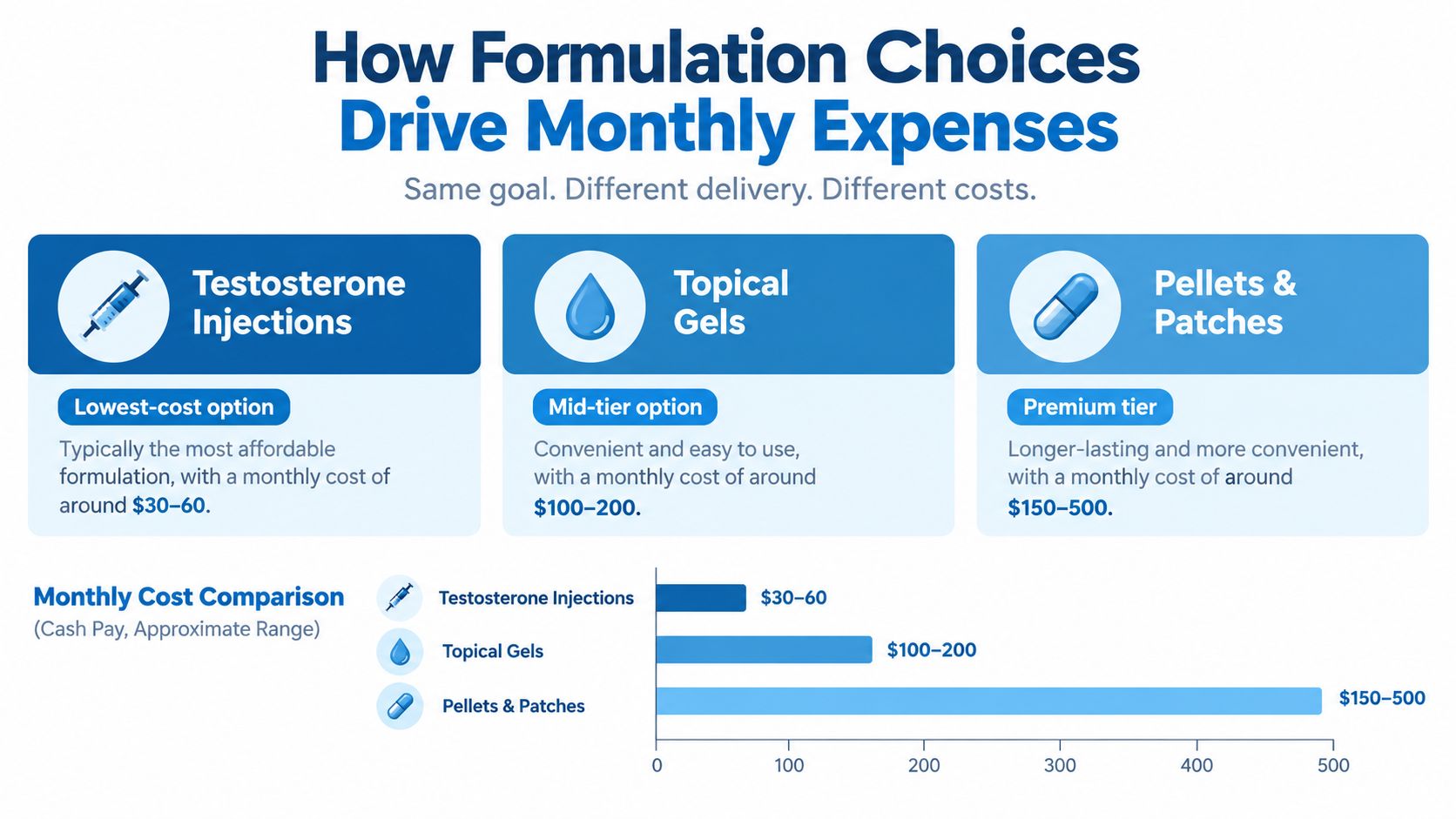
The delivery method often determines whether testosterone therapy remains manageable or becomes a recurring financial strain. Generic injectable testosterone cypionate is usually the budget choice , while topical products, oral capsules, and pellets can carry much higher cash prices.
The reason is practical. Injectable testosterone uses a widely available generic formulation and generally requires less expensive dispensing than specialized topical or implantable options. Gels and creams add formulation and application considerations, oral products can carry a higher price, and pellets involve a procedure as well as the medication itself.
Start with the least expensive clinically appropriate option
Uninsured pricing guides place generic injectable testosterone cypionate at roughly $30 to $110 per month . Other consumer-health pricing information places injections around $20 to $100 or more monthly , with some discount-pharmacy scenarios reporting $15 to $30 per month . These ranges are summarized in this consumer guide to testosterone replacement pricing and this overview of uninsured TRT prices.
The lowest price doesn't make injections right for everyone. A patient must be comfortable with the administration method, follow the prescribed schedule, store the medication properly, and use safe injection technique. A clinician should also determine whether a patient's health history makes one formulation more appropriate than another.
Topicals can be easier for some patients because they avoid injections, but the price can be much higher. Available uninsured pricing guides place gels and creams around $200 to $500 or more per month , with another source reporting a range of $400 to $1,000 monthly . Oral capsules can reach $400 to $1,000 per month in one guide and $1,000 to $2,000 monthly in another.
Pellets represent a different financial pattern. One guide places a pellet course around $1,200 , rather than presenting it as a simple medication subscription. Before choosing pellets, ask how often the procedure is repeated, what the quoted course includes, and whether follow-up visits or laboratory testing are billed separately.
Convenience has a price
A cost-conscious patient should ask the clinician to compare formulations across three dimensions: monthly price, administration burden, and expected follow-up needs. A more expensive option may be reasonable if it solves a genuine adherence or tolerance problem, but convenience alone shouldn't push a patient into a long-term expense they can't sustain.
Read what the evidence says about compounded hormones before accepting a compounded product just because a clinic recommends it. The clinician should explain why the formulation is appropriate, how quality is assessed, and what lower-cost alternatives exist.
The Hidden Value of Metabolic and Lab Monitoring
Testosterone therapy doesn't happen in isolation from the rest of the body. A patient may seek help for fatigue, reduced libido, mood changes, or sleep problems, while also having blood pressure concerns, abnormal glucose, lipid changes, or weight-related metabolic risk.
That makes laboratory monitoring part of the treatment, not an optional clinic add-on. Cutting the lab budget may make a monthly quote look better while removing information the clinician needs to assess response, identify adverse effects, and decide whether the treatment remains appropriate.
Testosterone care should include broader health context
Metabolic syndrome is diagnosed when a patient has at least three of five criteria . The criteria include waist circumference over 40 inches in men or 35 inches in women , triglycerides of at least 150 mg/dL , HDL below 40 mg/dL in men or 50 mg/dL in women , fasting glucose of at least 100 mg/dL , and blood pressure of at least 130/85 mm Hg , according to the National Center for Biotechnology Information's clinical reference.
Those measurements give a clinician a clearer picture than testosterone alone. A patient may need a plan that addresses hormonal symptoms alongside weight, glucose, blood pressure, and cardiovascular risk. That could involve disease management, medication management, nutrition changes, sleep support, or medically supervised weight loss, depending on the evaluation.
CDC materials use the same three-of-five framework and list sex-specific waist thresholds of 88 centimeters for women and 102 centimeters for men , along with the glucose, triglyceride, HDL, and blood pressure thresholds described above. The CDC discussion of metabolic syndrome criteria is useful when reviewing what a proposed lab panel is designed to assess.
Lab fees are a safety expense
Ask the clinic to identify which tests are required before treatment, which are used for follow-up, and whether an outside laboratory can perform them at a lower cash price. A provider who can't explain the purpose of a test deserves scrutiny, but a patient who refuses all monitoring also creates an unsafe treatment arrangement.
You can use this metabolic health testing guide to prepare questions before an appointment. Request an itemized estimate, but don't judge the plan solely by the number of tests. The appropriate panel depends on symptoms, medical history, current medications, and the clinician's assessment.
The cheapest safe plan is not the plan with no monitoring. It's the plan that uses necessary monitoring without charging for unexplained services.
Why Transparent Cash-Pay Models Benefit the Patient
Insurance can lower costs, but it can also add administrative obstacles. A patient may need documented symptoms, repeated morning testing, a specific diagnosis, and prior authorization before a plan will cover treatment. Someone who doesn't meet the insurer's criteria may still have symptoms that deserve a careful medical evaluation.
A transparent cash-pay model removes the question of whether the insurer will approve a claim. It doesn't remove the need for diagnosis or clinical judgment. The provider still needs to review the patient's history, evaluate symptoms, interpret testing, discuss risks, and decide whether testosterone therapy is medically appropriate.

What a patient-centered model should show clearly
For Mississippi patients, a sensible direct-pay clinic model should make the following visible before enrollment:
- The first appointment cost: You should know what the initial consultation covers and whether testing is separate.
- The recurring charge: Ask whether the monthly fee includes medication, supplies, consultations, and follow-up care.
- The treatment boundaries: A clinic should explain which symptoms and diagnoses it treats and when it refers a patient to another medical professional.
- The provider relationship: Confirm whether a qualified medical provider reviews your results and adjusts treatment when needed.
- The cancellation terms: Understand what happens if you pause therapy, change medications, or stop attending.
A bundled plan can offer better financial predictability than a low medication price followed by separate charges. It can also reduce the administrative burden of coordinating a prescriber, pharmacy, laboratory, and follow-up schedule. That value matters for patients who work irregular hours, have transportation challenges, or feel overwhelmed by medical paperwork.
Transparent doesn't mean automatically inexpensive
A cash-pay model isn't automatically the cheapest choice. A retail prescription may cost less for a patient who needs a basic generic injectable and already has reliable medical supervision. A clinic membership may be worth the additional cost when it includes services the patient would otherwise purchase separately.
The strongest model is the one that states its inclusions plainly. Before booking, review how to find a doctor without insurance and prepare a list of symptoms, medications, prior test results, and budget limits.
A Mississippi provider should offer an in-person evaluation when appropriate, explain the treatment plan in plain language, and provide ongoing support rather than treating the prescription as the entire service. Direct-pay care works best when the patient knows exactly what is included and what remains outside the package.
Strategies to Estimate and Reduce Your First-Year Costs
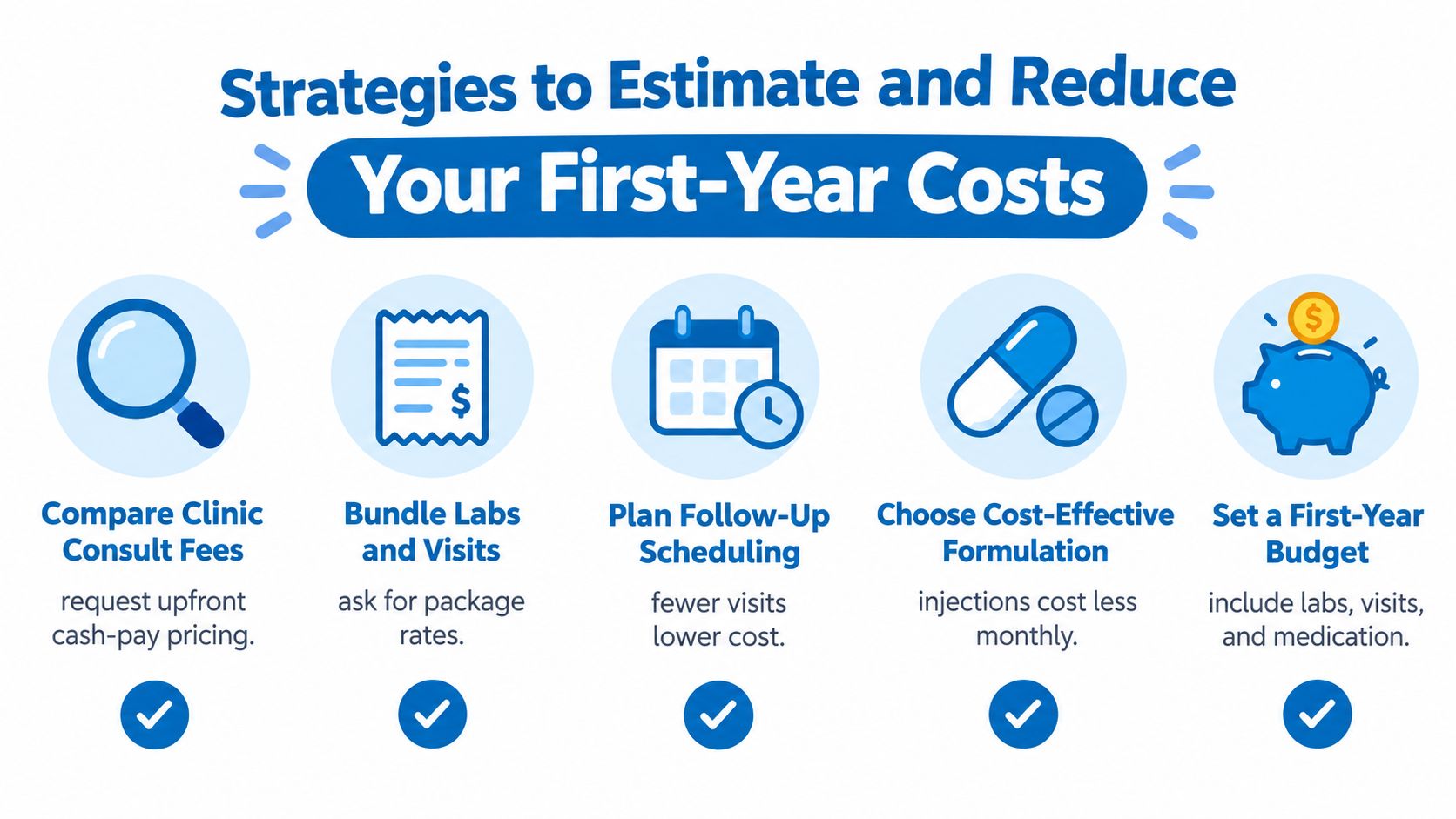
A first-year budget should begin with the complete care pathway, not the cheapest medication quote. Write down every expected category, ask the provider for a cash-pay estimate, and compare equivalent plans.
Use this formula as a planning tool:
First-year cost = initial evaluation + diagnostic testing + medication + supplies + follow-up visits + monitoring labs.
Don't assume that a monthly membership includes every item. Some programs bundle care, while others separate the evaluation, laboratory work, medication, and follow-ups.
Five practical ways to control the bill
-
Compare complete quotes: Request the initial visit, lab, medication, supplies, and follow-up prices in writing. A quote that lists only testosterone isn't enough for a fair comparison.
-
Ask about generic injectables: If the clinician says injections are medically appropriate, ask whether generic testosterone cypionate is available through a retail pharmacy. It is generally the lowest-cost formulation in uninsured pricing guides, but your provider should determine whether it's suitable.
-
Clarify the monitoring schedule: Ask what each lab measures and when it is needed. Don't ask to eliminate clinically necessary testing, but do challenge unexplained duplicate services or arbitrary add-ons.
-
Compare bundled and unbundled care: Add the retail medication, separate clinician visits, laboratory charges, and supplies before deciding that a pharmacy prescription is cheaper. Then compare that total with the clinic's monthly package.
-
Budget for treatment continuity: Testosterone therapy may be ongoing. Choose a formulation and care model that you can maintain rather than starting with a price you won't be able to afford later.
Questions to ask before signing up
Bring these questions to the consultation:
- Does the monthly fee include the medication?
- Are injection supplies included?
- Is the initial evaluation separate?
- Are confirmation visits billed separately?
- How are follow-up visits scheduled and priced?
- Can I use an outside laboratory?
- What happens if my dose changes?
- What happens if I pause or discontinue treatment?
- Is a retail generic prescription a reasonable alternative for me?
- Which services are excluded from the advertised price?
A provider who answers directly makes budgeting easier. A provider who avoids itemized pricing creates avoidable financial risk.
Don't reduce expenses by buying testosterone from an unverified online seller, sharing medication, skipping necessary testing, or changing the dose without medical guidance. Those choices can create health risks and make the treatment harder to manage.
Answers to Common Cash-Pay TRT Questions
Is cash-pay TRT cheaper than insurance?
Sometimes, but not always. Cash pay can be less frustrating for a patient whose insurer requires extensive documentation or denies coverage, but the patient pays the full expense. Compare the insurer's actual out-of-pocket responsibility, including deductibles, copayments, laboratory costs, and authorization delays, with a written direct-pay estimate.
The least expensive route is often a generic injectable prescription combined with a clinician who provides appropriate monitoring. A clinic membership may cost more while giving you a single point of contact for treatment decisions, follow-up, supplies, and lab coordination.
What happens if I need to pause treatment?
Ask before starting. A responsible provider should explain whether you need a follow-up visit, how prescriptions are handled, whether unused medication can be stored, and what symptoms or changes require medical attention.
Don't stop or restart testosterone based only on the price. A pause may affect symptom management and should be discussed with the prescribing clinician, particularly if you have other health conditions or take medication for metabolic, cardiovascular, thyroid, or psychiatric concerns.
Is telehealth-only care safe?
Telehealth can be useful for follow-up and medication discussions, but it shouldn't replace an appropriate initial evaluation. Mississippi patients should ask how the provider verifies identity, reviews laboratory results, handles urgent concerns, coordinates testing, and arranges an in-person assessment when needed.
A telehealth clinic that sells medication without meaningful evaluation is a poor choice. A local provider that offers in-person assessment and ongoing communication may be more suitable for someone starting treatment or managing several health concerns.
What if insurance denied my treatment?
Request the denial reason and ask whether the insurer requires additional documentation or repeat testing. If you choose cash pay, keep copies of your records, laboratory results, diagnosis, medication list, and treatment plan so another clinician can understand your history.
Low testosterone symptoms can overlap with sleep disorders, depression, medication effects, thyroid conditions, diabetes, metabolic syndrome, and other causes of fatigue or reduced libido. A careful evaluation should look beyond one symptom and avoid treating every problem as a testosterone deficiency.
How can I tell whether a quote is honest?
Ask for the all-in first-year estimate and the expected ongoing monthly cost. If the clinic advertises a medication price, ask what that price excludes. A clear answer is more useful than a dramatic discount.
Medical weight loss may also become part of a broader metabolic plan. Clinical summaries report average weight loss of about 15% with semaglutide in people without diabetes and about 20% with tirzepatide , with phase 3 trial benchmarks of 14.9% for once-weekly semaglutide 2.4 mg , 15.0% for tirzepatide 5 mg , and 20.9% for tirzepatide 15 mg , as summarized by Stanford Medicine's GLP-1 overview and this clinical comparison of GLP-1 weight-loss results. Those treatments aren't substitutes for testosterone therapy, but they show why a complete assessment may need to address hormone symptoms, weight gain, metabolic health, and medication management together.
Pause Medical offers hormone replacement therapy, medically supervised weight loss, and disease management through direct-pay care for Mississippi patients, with provider evaluations and personalized treatment planning. Visit Pause Medical to review the available services and schedule a consultation that covers your symptoms, lab needs, formulation options, and true cash-pay cost.