TRT Clinics That Accept Insurance: How to Find Coverage
You wake up tired even after a full night of sleep. Your workouts feel flat. Your motivation is off. Your sex drive isn't what it used to be. So you do what is a typical first step in Mississippi. You check your insurance card and start searching for TRT clinics that accept insurance.
That's when the confusion starts.
One clinic says it “works with insurance.” Another says it can provide receipts for reimbursement. A third tells you labs may be covered, but the visit package isn't. Then your insurer's directory lists doctors who treat hormone issues, but nobody can tell you on the phone whether testosterone therapy itself is likely to be approved. For many patients, that's the moment the process stops feeling medical and starts feeling like a billing puzzle.
This issue comes up constantly in men's health. Patients assume that if a condition affects energy, libido, mood, muscle mass, and quality of life, insurance should handle it like any other legitimate treatment. Sometimes it does. Sometimes it doesn't. More often, it covers part of the process and leaves the most important part in a gray area.
The Confusing Search for Insurance-Covered TRT in Mississippi
A common Mississippi scenario looks like this. A man in Jackson, Tupelo, Meridian, Starkville, or Oxford starts noticing persistent fatigue, low motivation, reduced libido, trouble maintaining muscle, or a general drop in vitality. He isn't looking for an “anti-aging” package. He wants a medical answer and hopes insurance will help pay for it.

The search usually starts online with terms like “TRT clinics that accept insurance near me” or “low testosterone doctor Mississippi.” Then the mixed signals begin. A clinic may mention insurance on its website, but that doesn't automatically mean it bills your plan for the consultation, the testosterone prescription, the follow-up visits, and the ongoing monitoring. Those are different parts of care, and they aren't always handled the same way.
Why patients get stuck early
Insurance language sounds simple until you try to apply it. “Covered” can mean the office visit is billed. It can mean only the blood work is sent through insurance. It can mean the prescription might go through a pharmacy benefit if you meet strict requirements. It can also mean none of those things until prior authorization is approved.
Many patients don't have a medical problem finding a provider. They have a transparency problem finding out what that provider actually bills.
That's why it helps to start with a specialist who understands men's health and hormone symptoms, not just a general directory listing. If you're beginning that process, find a specialist for men's health in Mississippi before you spend hours calling offices that may not handle TRT regularly.
The real gap
The biggest disconnect isn't between patients and doctors. It's between what clinics advertise and what insurers will reimburse . Once you understand that gap, the process becomes frustrating but navigable. You can stop chasing vague promises and start asking the right questions.
Decoding What Insurance Requires for TRT Coverage
Most insurers don't cover testosterone therapy because a patient feels tired, stressed, older, or “off.” They cover it when the chart supports medical necessity for diagnosed hypogonadism.
According to Denver Regenerative Medicine's summary of TRT insurance requirements, major carriers including Blue Cross Blue Shield, Aetna, UnitedHealthcare, and Cigna typically require two separate early-morning blood tests between 8 AM and 10 AM showing total testosterone below 300 ng/dL , with some plans using 250 ng/dL , plus documented symptoms and a Letter of Medical Necessity. Without that documentation, claims are often denied as not medically necessary or categorized as anti-aging treatment.

What has to be in the chart
If you're trying to use insurance, vague symptoms won't help. The record usually needs specific complaints tied to function and quality of life.
That often includes documentation of symptoms such as:
- Fatigue that persists: not just a bad week, but an ongoing issue affecting work, exercise, or daily routine.
- Sexual symptoms: reduced libido or erectile dysfunction are commonly relevant in charting.
- Physical decline: muscle loss, weakness, or decreased performance can matter when paired with low labs.
- Mood or cognitive changes: if they're discussed clinically and tied to suspected hormone deficiency.
- Bone or body composition concerns: these may support the picture when documented by the provider.
Timing matters more than people expect
A lot of patients get tripped up on logistics, not diagnosis. If your blood draw happens outside the required morning window, or if the second test isn't spaced appropriately, the insurer may treat the workup as incomplete. The same goes for missing notes or a chart that says “interested in optimization” instead of documenting functional symptoms.
Here's a simple way to consider this:
| Insurance requirement | Why it matters |
|---|---|
| Early-morning labs | Testosterone levels fluctuate, so timing affects coverage decisions |
| Repeat testing | Insurers want confirmation, not a single low reading |
| Symptom documentation | Low numbers alone often aren't enough |
| Letter of Medical Necessity | This ties the diagnosis to the treatment request |
| Prior authorization | Many plans won't pay without approval in advance |
Practical rule: If the chart is sloppy, the claim usually is too.
If you're budgeting for the full evaluation process, it also helps to understand how basic medical visits are coded and billed. A useful primer is Patient Talker LLC on physical exam costs, especially if you're trying to sort out what part of your initial workup may fall under a standard office visit versus hormone-specific management.
For patients who want the medical side organized before they chase insurance, this guide on how to start hormone replacement therapy is a practical first stop.
Strategies for Finding Potential TRT Clinics
Searching for TRT clinics that accept insurance in Mississippi works better when you stop using broad wellness terms and start using provider-type and diagnosis-specific language. Insurance companies organize care around specialties and billing categories, not around the phrases patients naturally type into Google.
Search by specialty, not marketing label
Instead of searching only for “TRT clinic near me,” try combinations that reflect how insurers think:
- Use insurer plus specialty: “Aetna endocrinologist Jackson MS” or “UnitedHealthcare urologist Mississippi low testosterone”
- Use diagnosis language: “hypogonadism doctor Tupelo” or “andropause evaluation Flowood”
- Use medication and benefits terms: “testosterone cypionate in-network provider Mississippi”
- Use geographic intent: add your city or nearby region so results don't drift into telehealth ads
That won't guarantee a fit, but it reduces the number of clinics whose websites focus on optimization, memberships, or wellness bundles that may not align with covered care.
Use your plan directory, but don't trust it blindly
Insurer directories are still worth using. They can give you names of endocrinologists, urologists, primary care physicians, and men's health providers who are at least listed as in-network.
The problem is that a directory entry doesn't answer the questions patients need answered. It usually won't tell you whether the practice is accepting new hormone patients, whether that provider treats testosterone deficiency regularly, or whether the office is efficient with prior authorizations.
A short screening process helps:
- Make a list of providers from your insurer's directory
- Check each practice website for men's health, endocrinology, or hormone care
- Call and ask whether they evaluate low testosterone, not just whether they “do TRT”
- Confirm they're seeing Mississippi patients in person if that matters to you
- Ask if the office handles prior authorization submissions
Build a short list, not a giant one
Patients often waste time calling too many offices. A better approach is to create a short list of three to five realistic options and compare them on responsiveness, transparency, and experience with hormone treatment.
A statewide starting point helps if you're trying to narrow by geography first. This directory of Pause Medical locations in Mississippi can help you orient by region and reduce the back-and-forth of calling offices that aren't near you.
A provider being in-network is useful. A provider knowing how to document and manage TRT coverage is what saves time.
Critical Questions to Ask Clinics and Insurers
Most of the money confusion gets solved.
A clinic can state it accepts insurance and still leave you paying out of pocket for the main service. That's the phantom acceptance problem. According to Policy Lab's review of online TRT models, in 2026 most specialized TRT clinics operate on a direct-pay or concierge model, with patients paying upfront and using insurance only for eligible labs and prescriptions. That creates a situation where “insurance acceptance” sounds broader than it really is.

Questions to ask the clinic
Don't ask only, “Do you take my insurance?” That question is too broad to be useful. Ask narrower questions that force a clear answer.
- For the consultation: “Do you bill my insurance for the initial visit, or is that self-pay?”
- For labs: “Are blood tests billed through my insurance, through an outside lab, or included in a package?”
- For medication: “Is the testosterone prescription sent to a regular pharmacy under my plan, or dispensed through the clinic as cash pay?”
- For follow-up care: “Are follow-up visits billed to insurance, or are they membership-based?”
- For network status: “Is the provider in-network, or is the clinic only helping me submit out-of-network paperwork?”
- For common patient cost patterns: “What do patients with my plan usually pay for the visit side versus the medication side?”
A transparent clinic should answer those questions directly. If the answers stay fuzzy, assume the billing will too.
Questions to ask your insurer
Your insurance company needs a different set of questions. Focus on policy details, not general customer service language.
Ask:
- Coverage criteria: “What are your requirements for testosterone therapy medical necessity?”
- Prior authorization: “Is prior authorization required before the prescription is covered?”
- Formulary status: “Which testosterone formulations on my plan are preferred?”
- Provider requirements: “Does the prescriber need to be in-network or a certain specialty?”
- Pharmacy benefit rules: “Is generic injectable testosterone covered differently from gels or other forms?”
- Denial steps: “If prior authorization is denied, what is the appeal process?”
Here's a quick way to spot the difference between real coverage and phantom acceptance:
| Claim you hear | What it may actually mean |
|---|---|
| “We accept insurance” | The office visit may be billed, but the program may still be self-pay |
| “Insurance can be used” | Labs or pharmacy claims may run through benefits, not the clinic fee |
| “Most patients use insurance” | Often means partial use, not full treatment coverage |
| “We'll help with reimbursement” | You may pay upfront and submit paperwork yourself |
The distinction matters because core TRT care often includes evaluation, prescribing, monitoring, medication management, and follow-up. If only one of those pieces runs through insurance, you don't have full insurance-covered treatment.
A short video explanation can help if this still feels abstract.
“Do you bill insurance for the treatment itself?” is the question that clears the fog faster than anything else.
Navigating Prior Authorizations and Common Denials
Once you find a clinic that looks promising, the paperwork stage starts. At this point, many patients assume the hard part is over. It usually isn't.
What prior authorization is really doing
Prior authorization is the insurer's gatekeeping step. The provider submits clinical notes, lab results, diagnosis support, and the requested medication. The insurer reviews whether the request matches its internal coverage rules before it agrees to pay.
In practical terms, your prescriber may need to submit:
- Morning lab documentation: the insurer wants the right labs, drawn at the right time
- Symptom notes: chart language needs to support functional impairment
- Diagnosis details: the request has to line up with the medical record
- Medication choice: if the requested form falls outside the plan's preferred options, denial risk rises
Common reasons claims get denied
Some denials are clinical. Many are administrative.
A request may be denied when the chart doesn't clearly support the diagnosis, when the lab timing is off, or when the medication requested falls into a category insurers commonly exclude. That issue comes up often with hormone products that aren't standard, FDA-approved pharmacy benefit items.
According to Exceed Health Clinic's review of hormone coverage, insurance plans generally cover FDA-approved bioidentical hormone therapies such as estradiol patches, gels, oral tablets, and standard progesterone formulations under pharmacy benefits, while non-FDA-approved options like compounded hormones or hormone pellets are generally excluded from coverage . That doesn't mean those options are never considered clinically. It means they are frequently a poor fit for insurance approval.
When the prescribed treatment doesn't match the plan's preferred product pathway, denials become much more likely.
If your clinic is faxing records, refill requests, or specialty medication documentation, practical details matter more than they should. Something as basic as the right destination can prevent delays, which is why resources like this CVS Specialty Pharmacy fax number guide can be useful when a prior authorization or pharmacy handoff keeps stalling.
How to respond after a denial
A denial isn't always the end of the road. It often means the first submission was incomplete, poorly documented, or mismatched to the plan's rules.
A stronger appeal usually starts with a medication and chart review. If you need ongoing help organizing prescriptions, follow-ups, and insurer-required documentation, structured medication management support can make the process far less chaotic.
The Clear Path to TRT A Simple Alternative
After patients spend days calling clinics, checking directories, repeating labs, and waiting on prior authorization, many decide they don't want insurance deciding every detail of treatment. That's a reasonable conclusion.
A direct-pay model isn't a fallback. In many cases, it's the cleaner path. You know what the clinic charges. You know what's included. You aren't stuck wondering whether the visit is covered but the treatment plan isn't, or whether a clinic that “accepts insurance” only means your lab order might go through.

Transparency often beats partial coverage
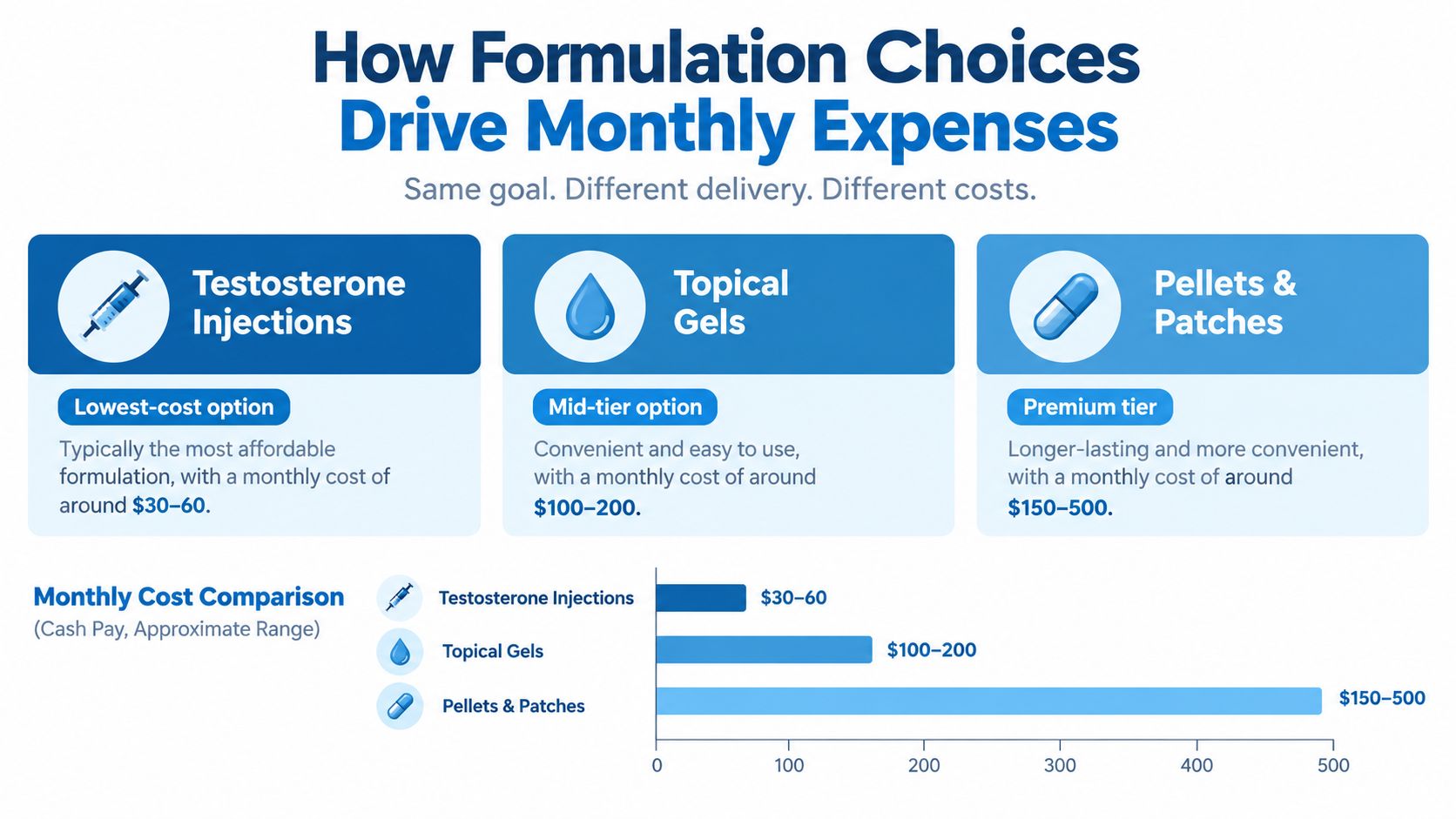
According to US Men's Medical Center's TRT cost overview, average TRT costs vary by delivery method, with injections ranging from $40–$150 per month , topical gels from $150–$500 per month , and patches from $200–$500 per month , while total out-of-pocket costs often span $100–$500 per month depending on dosage and added prescriptions. Those ranges matter because they show why patients need clear pricing before they commit to a clinic model.
When a clinic is direct-pay and upfront about costs, you can compare options. If a self-pay visit plus affordable medication is simpler than months of insurer back-and-forth, many patients prefer the clarity.
What works better in real life
The insurance route works best when all of these line up at once: your labs fit the plan's cutoff, your symptoms are well documented, your provider knows how to submit clean authorizations, and your plan prefers the specific formulation prescribed. That happens. It just doesn't happen as often or as smoothly as patients expect.
The direct-pay route works better when you value speed, predictable billing, and treatment decisions based on clinical fit instead of payer preference. Many patients also use HSA or FSA funds when available, which can soften the financial hit even when the clinic doesn't bill insurance directly. If you're trying to compare cash pricing models before deciding, this breakdown of Cost Plus TRT's costs is a useful companion resource.
For Mississippi patients who want a simpler option close to home, home testosterone therapy may offer a more practical path than chasing fragmented insurance approval across multiple providers and billing systems.
The right choice isn't always the one that looks cheapest on paper. It's the one that gives you a realistic path to evaluation, treatment, monitoring, and follow-through without constant billing confusion.
Medical disclaimer: Testosterone therapy isn't appropriate for everyone. A licensed clinician should evaluate symptoms, lab work, medical history, medication use, and treatment goals before any hormone plan begins. Insurance rules and pharmacy benefits vary by plan, and coverage decisions can change.
If you're in Mississippi and tired of sorting through half-answers about TRT coverage, Pause Medical offers a more transparent way to move forward. You can schedule a consultation, review your symptoms with a qualified provider, and get a personalized treatment plan without guessing what a clinic means by “accepts insurance.” For patients dealing with low energy, low libido, weight changes, or other signs of hormone imbalance, that clarity matters.