No Medical Insurance Fine: 2026 Rules and Care Options
The federal no medical insurance fine was reduced to $0 beginning in 2019 , so most Americans don't face a federal tax penalty for going without coverage. However, California, Massachusetts, New Jersey, Rhode Island, and Washington, D.C. still impose state-level penalties, so your filing location matters.
The popular advice, “You don't need insurance anymore,” is too broad to be safe. The federal penalty disappeared, but healthcare access, state tax rules, and the cost of paying for specialized treatment remain separate questions. For Mississippi residents, the practical issue is usually not an outdated federal fine. It's how to get affordable, coordinated care for hormone concerns, weight management, chronic disease, or preventative wellness without waiting for an insurer to approve every step.
The Truth About the Federal Health Insurance Penalty
The federal government no longer charges a tax fine because you lacked minimum essential health coverage. The Affordable Care Act's federal individual mandate penalty was set to zero for tax years beginning in 2019 , although the legal coverage language remained in federal statute. The enforcement mechanism disappeared, which is why people who live in Mississippi and file Mississippi taxes won't owe a federal no medical insurance fine.
That distinction causes persistent confusion. A legal requirement can remain on paper while the financial consequence is eliminated. Federal guidance confirms that people generally don't need an exemption to avoid the federal penalty, but it also warns that some states maintain their own rules. You can review the federal position and state exceptions through Healthcare.gov's penalty explanation.
Practical rule: Don't buy or skip coverage based on an old ACA penalty chart. Check the current rules for the state where you file taxes.
Mississippi doesn't appear among the jurisdictions listed by federal guidance as imposing a state-level individual mandate penalty. That means Mississippi residents should focus less on fear of a federal tax bill and more on whether their healthcare arrangement protects them from major medical expenses and gives them practical access to care.
For plain-language background on insurance decisions, preventive planning, and patient questions, Pause Medical also provides patient education materials for better healthcare decisions. If you're comparing coverage with direct-pay care, a current explanation such as My Policy Quote on 2026 insurance fines can help you identify outdated assumptions before making a tax or healthcare decision.
The federal answer is reassuring, but it doesn't mean being uninsured is risk-free. Insurance can help with hospital care, emergencies, prescriptions, and serious illness. Direct-pay care can address specific needs such as hormone replacement therapy, medical weight loss, and medication management. Those choices solve different problems, and patients shouldn't confuse the absence of a tax fine with the absence of medical or financial risk.
How the ACA Mandate Penalty Evolved and Disappeared
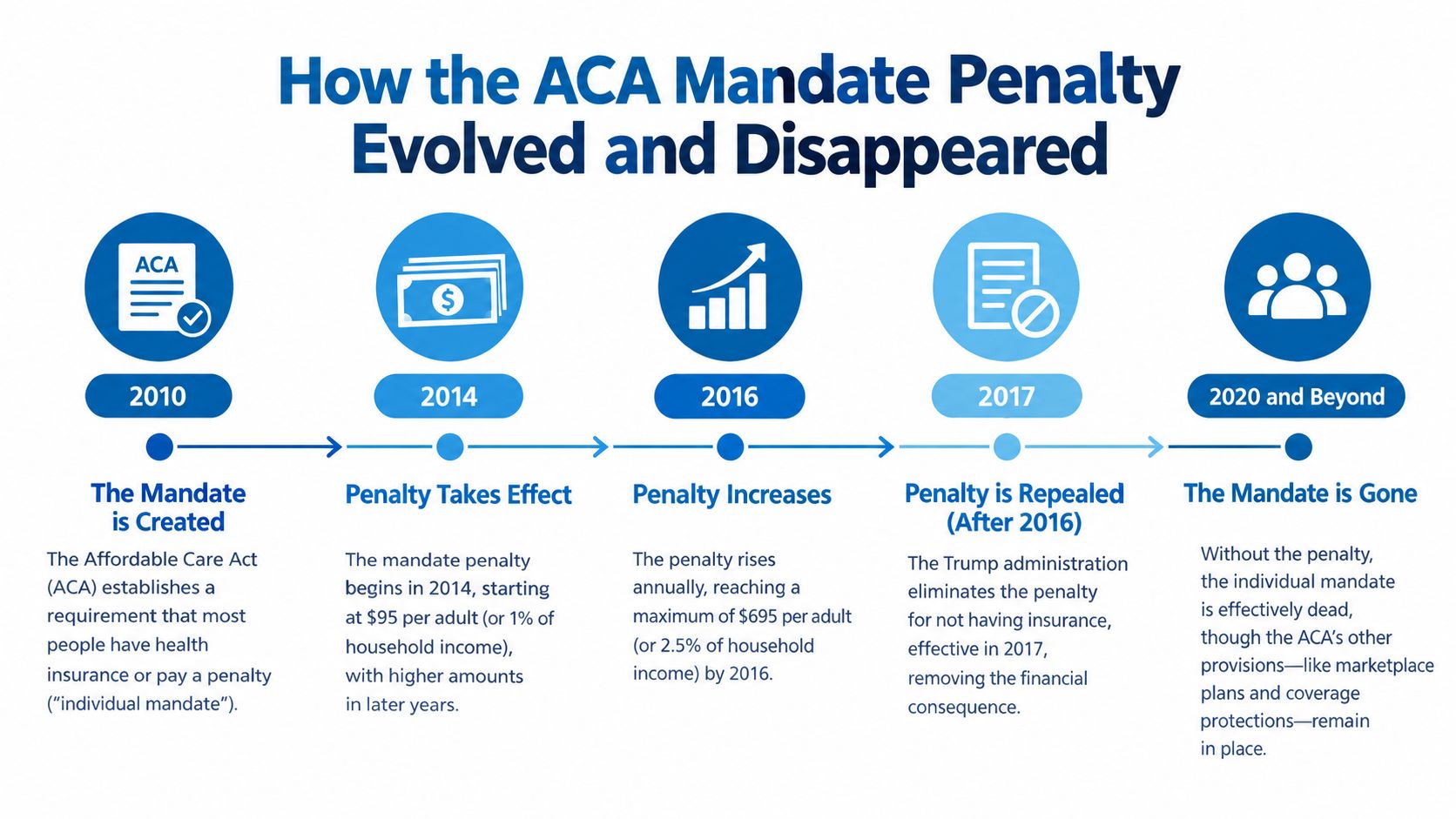
The former federal penalty used a dual calculation. A taxpayer generally owed whichever was greater, a flat-dollar amount or a percentage of household income above the tax-filing threshold. The formula became more demanding over the first years of enforcement.
In 2014 , the penalty began at the greater of $95 per adult or 1% of household income above the tax-filing threshold . It rose in 2015 to $325 per adult or 2% , then reached $695 per adult or 2.5% from 2016 through 2018 . Annual limits also related to the national average bronze-plan premium, so the final amount could vary by household circumstances. The Congressional Research Service history of the individual mandate documents this progression.
Why the federal charge ended
The penalty did not fade away because the IRS stopped enforcing it without fanfare. Congress changed the amount through the Tax Cuts and Jobs Act , setting the federal penalty to $0 beginning with the 2019 tax year . The coverage language remained, but the federal government no longer had a financial enforcement tool attached to it. The Congressional Research Service policy summary describes this as a major change in federal insurance policy.
The old system affected a substantial number of tax filers before it ended. In 2018, an estimated 3.80 million taxpayers paid the mandate penalty , and the average penalty paid by affected tax filers reached about $835 , according to the Congressional Research Service. Those figures explain why people still search for the no medical insurance fine. The concern was once justified.
That history matters, but it shouldn't control a 2026 decision. A federal penalty that applied in 2018 isn't a current bill for a Mississippi taxpayer. Your present decision should instead account for the value of coverage, your expected healthcare needs, and whether direct-pay services can fill a specific gap.
State-Level Insurance Mandates You Still Need to Know
The federal penalty is gone, but the question is not settled everywhere. California, Massachusetts, New Jersey, Rhode Island, and Washington, D.C. still maintain state or district requirements that may create a tax penalty for residents without qualifying coverage. Vermont keeps an individual mandate but does not impose a dollar penalty.
Your filing jurisdiction matters more than the location where you receive care. Someone living in Mississippi may still need to check another jurisdiction's rules if that is where they file or had a tax obligation. Liability can depend on income, household circumstances, the length of a coverage gap, affordability, and available exemptions.
| State / District | Penalty status | Key exemption rule |
|---|---|---|
| California | State penalty applies to qualifying uninsured residents | Exemptions may apply, and the penalty depends on household and income circumstances |
| Massachusetts | State penalty applies under its individual mandate | No penalty applies for gaps of 63 consecutive days or less ; people at or below 150% of the federal poverty level aren't penalized |
| New Jersey | State penalty applies to qualifying uninsured residents | Exemptions and affordability rules can affect liability |
| Rhode Island | State penalty applies to qualifying uninsured residents | Exemptions may apply under state rules |
| Washington, D.C. | District penalty applies to qualifying uninsured residents | Exemptions may apply through district procedures |
| Vermont | Individual mandate remains | Vermont doesn't impose a dollar penalty for lacking coverage |
What Mississippi residents should do
Mississippi residents generally do not calculate a state no medical insurance fine solely because they live in Mississippi. Confirm your tax residence, account for any move during the year, and retain records of coverage, income, and possible exemptions if another jurisdiction is involved. If you want to confirm where Pause Medical sees patients while sorting out your filing jurisdiction, review Pause Medical's Mississippi locations.
Massachusetts shows why a simple yes-or-no answer can mislead. Its system still uses affordability and minimum creditable coverage concepts, and its 2025 to 2026 framework recognizes short gaps. The Massachusetts Health Connector's minimum creditable coverage guidance summarizes the state's continuing affordability and short-gap rules.
California can also impose a meaningful state charge. State guidance says the penalty can reach $950 per adult and $450 per child for a full year without insurance . That rule applies to the relevant California tax situation, not to Mississippi residents merely because they encounter the figure online. Match the mandate to your filing jurisdiction before assuming you owe anything. For specialized wellness care in Mississippi, direct-pay options can offer a clearer path without making a state tax rule more complicated than it is.
Why Insurance-Free Direct Care is a Smarter Choice
Removing the federal penalty doesn't make traditional insurance useless. It does create room for a more deliberate strategy. Keep full coverage when you need protection from hospitalization, emergency treatment, expensive procedures, or ongoing prescription costs. Then consider direct-pay care when insurance restrictions make focused treatment slow, opaque, or difficult to access.
Specialized services often create friction inside standard insurance systems. A plan may require referrals, prior authorization, narrow networks, or documentation that doesn't reflect the patient's full goals. Hormone replacement therapy, testosterone therapy, bioidentical hormones, medical weight loss, GLP-1 weight loss programs, thyroid support, and chronic disease management may require a longer conversation than a brief covered visit allows.
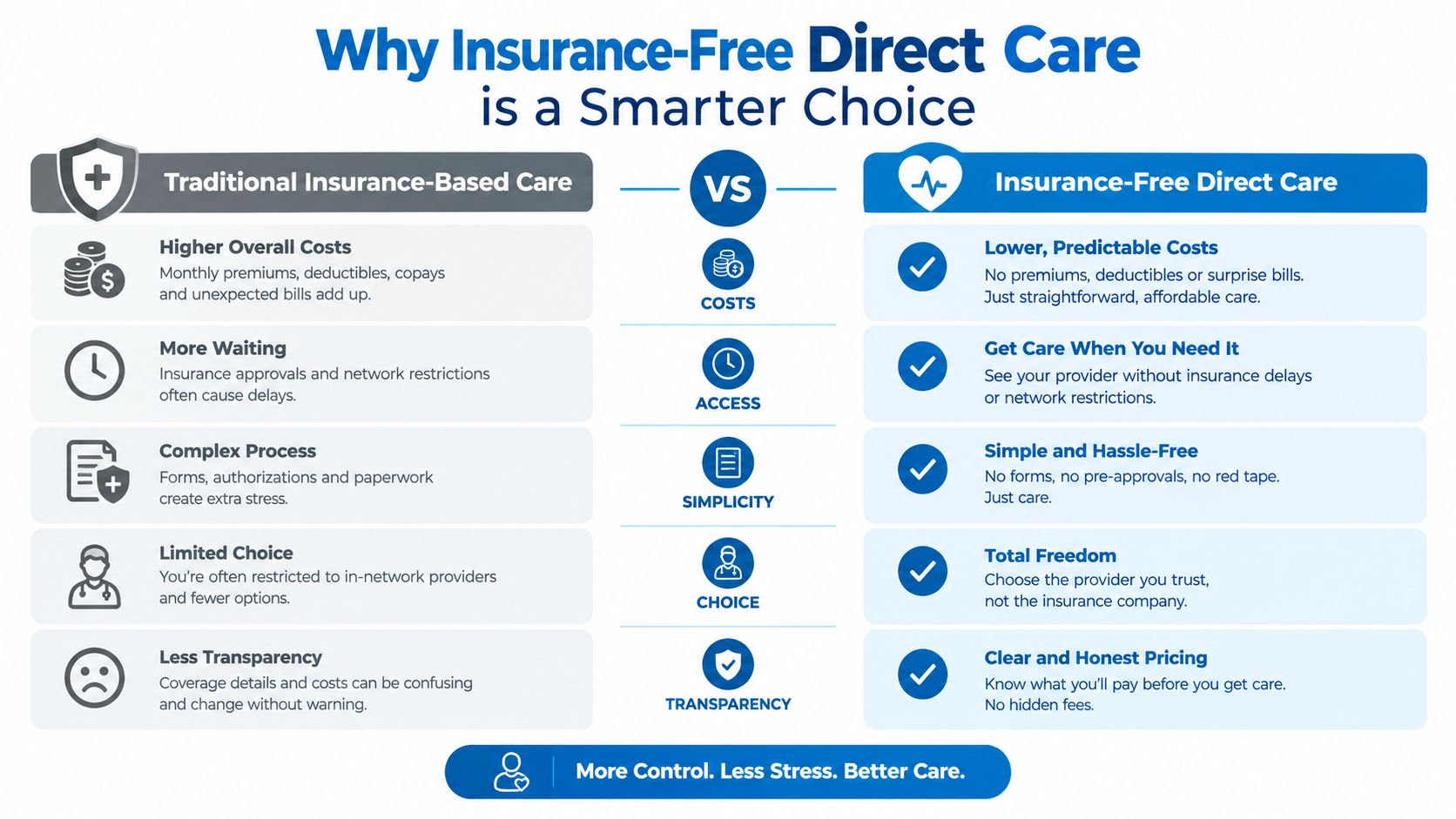
What direct-pay care changes
Direct care doesn't eliminate medical responsibility or make every treatment appropriate. It changes the payment and communication pathway.
- Transparent pricing: You can ask what a consultation, follow-up, laboratory review, or medication-management service costs before treatment begins.
- Focused appointments: The visit can center on symptoms such as fatigue, low libido, hot flashes, sleep disruption, weight gain, or mood changes.
- Personalized planning: A clinician can evaluate goals, medical history, current medications, and risk factors rather than treating one billing code in isolation.
- Fewer insurance barriers: You don't have to wait for an insurer to determine whether a specialized service fits its coverage policy.
For example, someone researching testosterone replacement therapy costs should separate the price of clinical oversight from the price of medication and testing. Testosterone therapy requires appropriate evaluation and monitoring. The same principle applies to estrogen or progesterone treatment, thyroid medication, and GLP-1 medications.
A direct-pay model is especially useful for patients who already have insurance but want a service their plan handles poorly. It can also help uninsured patients obtain structured care instead of delaying every concern until it becomes urgent. The smart approach is layered, not ideological. Use insurance for catastrophic protection when appropriate, and use transparent clinical care for defined wellness and disease-management needs.
Experiencing Personalized Care at Pause Medical
A patient seeking care for fatigue and weight gain shouldn't have to guess whether the problem is hormonal, metabolic, medication-related, sleep-related, or behavioral. A useful evaluation starts with the patient's history, symptoms, goals, and current treatment, then identifies what needs clinical attention.

Pause Medical's process is designed around that conversation. Patients schedule online, meet with a provider for an in-person evaluation, discuss concerns and treatment goals, and receive guidance on a plan suited to their situation. The model doesn't require insurance billing, which makes the conversation more direct for people comparing out-of-pocket options.
A plan built around the patient
A personalized treatment plan may address menopause symptoms, andropause concerns, reduced libido, poor sleep, metabolic health, or chronic disease management. Depending on the evaluation, the provider may discuss hormone replacement therapy , bioidentical hormones, testosterone therapy, medical weight loss, GLP-1 medications, thyroid disorders, diabetes, or medication management.
The purpose isn't to attach every symptom to a hormone imbalance. Good medical oversight asks whether the proposed treatment fits the patient's history and whether another condition, medication, or risk factor needs attention first. Hormone therapy and weight-loss medications require individualized screening, informed consent, follow-up, and monitoring.
Patients can review the clinic's approach to personalized treatment plans and custom care before scheduling. The right questions include what the consultation covers, which tests may be appropriate, how follow-up works, what medication costs are separate, and how the practice responds if symptoms don't improve.
The same clarity matters for GLP-1 treatment. Medicare's GLP-1 Bridge program is scheduled to run from July 1, 2026, through December 31, 2027 , with eligible Part D beneficiaries receiving covered weight-loss GLP-1 medications for a $50 monthly copay , subject to eligibility and authorization rules, as described by Medicare's weight-loss drug coverage information. The program applies to eligible Medicare beneficiaries, not every uninsured patient. KFF also explains that Medicaid coverage of GLP-1 drugs for obesity treatment is optional for states, while coverage is required for certain other approved indications, including diabetes, cardiovascular disease, and moderate-to-severe obstructive sleep apnea in adults with obesity, according to KFF's Medicaid GLP-1 coverage analysis.
Direct-pay care isn't a substitute for emergency treatment or full insurance when you need broad financial protection. It is a practical route for planned, supervised care when you want a clinician to address the underlying pattern rather than repeatedly treating isolated symptoms.
Taking Control of Your Health in Mississippi
For Mississippi residents, the tax question is usually straightforward. The federal penalty is zero, Mississippi isn't listed among the jurisdictions with a state-level penalty, and the remaining decision is how to secure care that fits your health needs and budget.
Don't let the end of the federal fine push you into neglecting symptoms. Persistent fatigue, hot flashes, low libido, sleep problems, unexplained weight gain, blood-sugar concerns, and thyroid symptoms deserve a clinical evaluation. They may reflect hormonal changes, metabolic disease, medication effects, sleep disorders, or several factors at once.
Pause Medical serves Mississippi communities near Oxford, Meridian, Tupelo, Flowood-Jackson, and Starkville . Its services include hormone replacement therapy, medical weight loss, disease management, and preventative wellness support, with provider-led evaluations and customized care. You can also review guidance on preventive health and taking control of your care.
Healthcare planning should reduce confusion, not add to it. Keep or obtain insurance when you need broad protection from major medical bills, and consider direct-pay care for specialized services that benefit from time, transparency, and ongoing clinical guidance. Above all, don't delay a meaningful health concern because you're worried about a federal no medical insurance fine that no longer applies.
Pause Medical offers board-certified medical oversight for hormone replacement therapy, medical weight loss, disease management, and personalized wellness care without requiring insurance. Visit Pause Medical to review your options and schedule a consultation at a Mississippi location.