How Long Should You Stay on HRT? a Practical Guide
There's no fixed limit on HRT, and major guidelines no longer impose a universal stopping age. Many people take HRT for five years or less , but continuation is decided through annual reassessment while the benefits outweigh the individual risks.
You feel better on hormone replacement therapy. The hot flashes have quieted, your sleep is less fragmented, and daily life feels manageable again. Then a question starts to nag: Does the prescription expire after a certain number of years?
The honest answer is, it depends on you . HRT duration is shaped by your age when treatment began, when menopause occurred, the symptoms you're treating, your personal risk profile, the type and dose of therapy, and what changes during follow-up. The core question is “How long should you stay on HRT?” It's “What should trigger continuing, lowering, switching, or stopping for my age, symptoms, and health history?”
Why There Is No One-Size-Fits-All Answer
Many patients arrive expecting a calendar rule. They've heard that HRT should stop after a few years, or that everyone should discontinue at a particular age. Modern guidance takes a different approach. The 2025 Menopausal Hormone Therapy Guidelines state that there's no universally recommended duration , no need for an arbitrary time limit, and no routine requirement to stop systemic therapy at age 60 or 65.
A large share of patients still use HRT for a relatively short period. Cleveland Clinic reports that most people take hormone therapy for five years or less , and patient guidance describes about 2 to 5 years as a common treatment period for vasomotor symptoms, although some people need longer. Those figures describe common practice, not a rule that overrides your symptoms or medical history.
Why the old five-year rule persists
The five-year idea grew from earlier interpretations of evidence, particularly concerns about breast cancer with combined estrogen-progestogen therapy after 3 to 5 years . Over time, that message was often simplified in waiting rooms and consumer articles into “everyone should stop after five years.” The actual clinical decision is more nuanced because risk depends on the person, the formulation, the route, the dose, and the reason for continuing.
Current guidance has moved from time-limited prescribing toward individualized duration. NHS guidance says there's no fixed limit for how long HRT can be used, while NICE recommends discussing duration at the outset and reviewing benefits and risks at every appointment. That's why a person with persistent, disruptive symptoms may reasonably have a different plan from someone whose symptoms have resolved.
Practical rule: HRT isn't a set-it-and-forget-it medication. It's a treatment plan that should earn its place at each review.
A personalized plan should document what you're treating, what improvement looks like, and which new symptoms or health changes would prompt a review. Pause Medical's personalized treatment plans describe this broader approach to individualized care. Your timeline should ultimately reflect symptom burden, treatment goals, risk, dose, route, and monitoring , not a stopwatch.
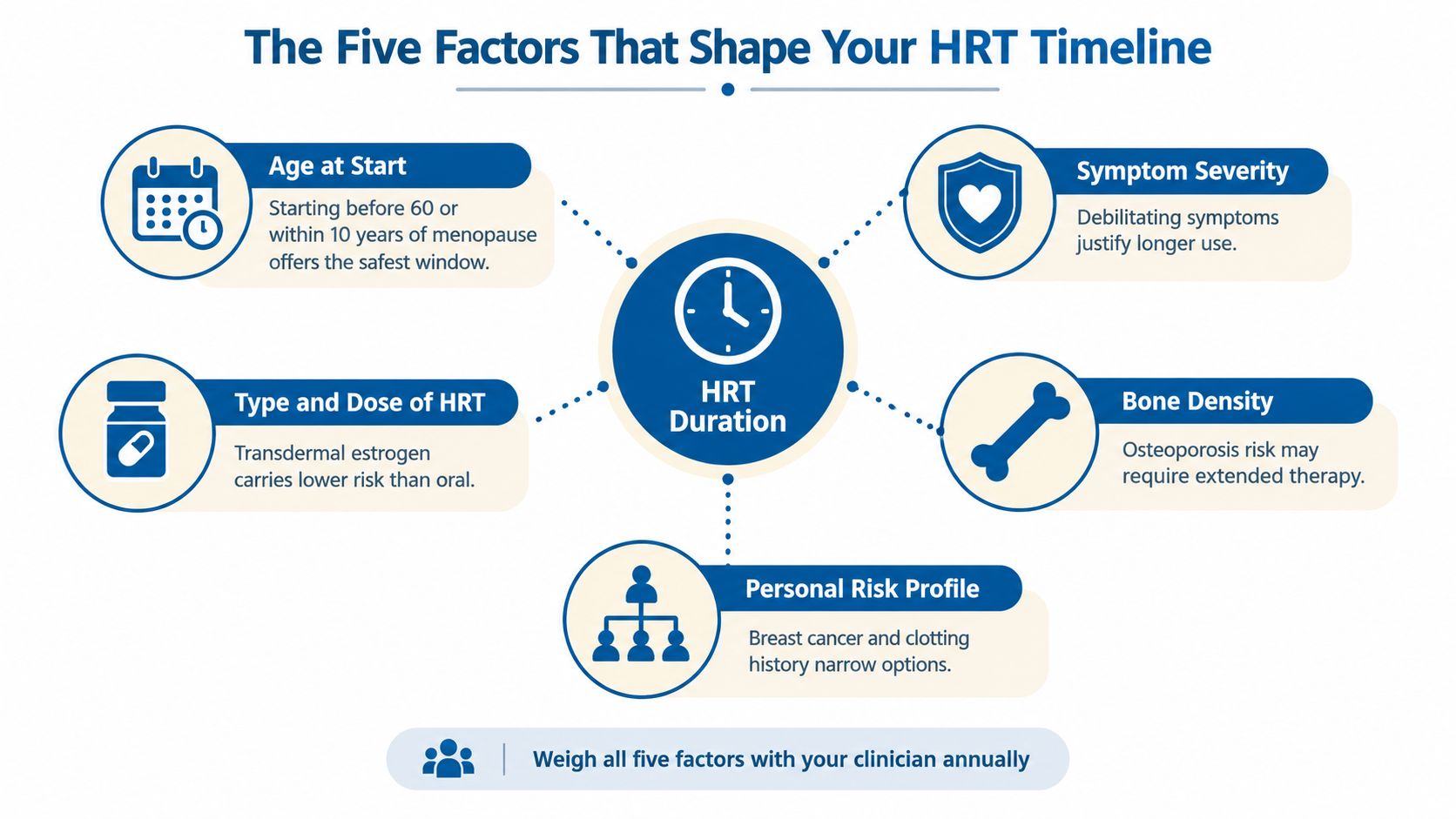
The Five Factors That Shape Your HRT Timeline
Think of HRT duration as a see-saw , not a countdown clock. One side holds symptom relief, quality of life, and possible bone benefits. The other holds individual risks, changing health conditions, and treatment burden. The see-saw gets checked repeatedly because both sides can shift.
1. Age and timing at the start
Starting before age 60 or within 10 years after menopause can change the benefit-risk discussion. The 2025 guideline notes that people in this group with persistent vasomotor symptoms, low cardiovascular and breast-cancer risk, and no good alternatives may be appropriate candidates for longer treatment. Starting later, especially in the presence of cardiovascular disease or other contraindications, calls for a different evaluation.
The timing of menopause also matters. Someone with premature ovarian insufficiency or early menopause may need hormone therapy until at least the average age of natural menopause, generally around 50 to 51 years , rather than using the duration of symptoms as the only measure.
2. Symptom severity and persistence
A mild, occasional warm spell creates a different treatment question from nightly sweats that prevent sleep and impair work. Persistent hot flashes, night sweats, vaginal symptoms, and sleep disruption can continue to justify therapy when the treatment remains medically appropriate.
Your clinician should ask whether symptoms are still active, whether they interfere with daily life, and whether nonhormonal alternatives would provide enough relief.
3. Your treatment goal
HRT might be prescribed mainly for hot flashes, vaginal symptoms, or a combination of symptoms. Bone health can also enter the discussion, but HRT shouldn't be used solely to prevent osteoporosis when other suitable medicines are available, according to government safety guidance.
4. Your personal risk profile
Personal history matters more than a generic age cutoff. Cardiovascular disease, breast cancer risk, clotting history, blood pressure, liver disease, unexplained bleeding, and family history can narrow options or change the route and dose your clinician considers.
5. Monitoring results
A stable plan can become less suitable after a new diagnosis, a change in blood pressure, a significant medication change, or a shift in symptoms. The dose and route should remain appropriate, and the treatment should stay at the lowest effective dose that meets your goals.
Pause Medical's overview of what hormones change during menopause can help you understand why symptoms and treatment needs may evolve. Bring a simple self-assessment to your appointment: What symptoms remain? What benefits do you notice? What risks have changed? What would make you comfortable trying a lower dose?
Typical HRT Timelines for Different Patients
A timeline becomes easier to understand when you compare real clinical situations. The same number of years can mean something different depending on whether treatment began during premature ovarian insufficiency, near the start of menopause, or later in life.
| Patient Scenario | Typical Duration | Key Rationale |
|---|---|---|
| Person with typical menopause and bothersome hot flashes | About 2 to 5 years is common, and most people use HRT for five years or less | Continue while symptoms and quality-of-life benefits outweigh risks |
| Person with premature ovarian insufficiency or early menopause | Until at least the average age of natural menopause, generally 50 to 51 years | Replaces hormones earlier than expected, followed by reassessment |
| Long-term user over age 65 with persistent symptoms | May continue beyond age 65 with periodic reassessment and attempts to taper or stop | Persistent symptoms, low risk, and lack of good alternatives can support continuation |
| Person using testosterone therapy | Duration is based on symptoms, treatment response, safety monitoring, and ongoing indication | Testosterone levels and related safety markers guide continuation |
A typical menopause timeline
For someone who begins HRT near the onset of menopause to control hot flashes, the initial plan often focuses on relief and reassessment. If symptoms settle, the clinician may discuss reducing the dose or attempting a planned stop. If symptoms return and the treatment remains appropriate, restarting or continuing may be reasonable.
Duration counts from menopausal timing and age , not just from the day symptoms became inconvenient. A person whose menopause occurred unusually early shouldn't automatically follow the same timeline as someone who reached menopause at the expected stage of life.
Patients also ask how quickly they should expect improvement before deciding whether treatment is worthwhile. A practical resource on how long HRT takes to work can help set expectations, while Pause Medical explains how long it can take for HRT to work in relation to symptom relief.
Long-term users and testosterone patients
Guidelines no longer recommend routine discontinuation at age 60 or 65. For a long-term user, continuation may be considered when symptoms remain significant, cardiovascular and breast-cancer risk are low, and alternatives aren't effective. The plan should include periodic attempts to taper or stop after age 65, not because the treatment automatically becomes forbidden, but because reassessment remains valuable.
Testosterone therapy follows its own monitoring logic. The American Urological Association recommends checking testosterone levels every 6 to 12 months while a patient remains on treatment. Other endocrine guidance supports checking testosterone and hematocrit at 3 to 6 months after initiation and then annually, with prostate monitoring in selected patients at 3 to 12 months after starting therapy. These checks help determine whether the indication remains valid and whether the dose remains safe.
What Happens If You Stay On or Stop HRT
The stay-versus-stop decision involves several outcomes that don't move together. Symptoms may improve while you continue. Bone protection may diminish after stopping. Some risks associated with longer use may fall after discontinuation. A responsible decision holds all of those facts at once.
If you continue
Continuing HRT may preserve relief from hot flashes, night sweats, vaginal symptoms, and other symptoms that respond to treatment. HRT also helps prevent osteoporosis during use, but it isn't automatically the right osteoporosis medication when other suitable treatments exist.
Longer use can also carry accumulating concerns. Government safety guidance explains that breast-cancer risk rises with several years of HRT use and moves back toward baseline after stopping. The same guidance notes that bone benefits diminish soon after discontinuation.
If you stop
Stopping may bring symptoms back, especially if the underlying menopausal transition continues. Some people remain comfortable, while others notice hot flashes, sleep disruption, mood changes, or vaginal symptoms returning. A return of symptoms doesn't mean you've failed or become dependent. It means the treatment was controlling an active problem.
Bone protection behaves a little like a light switch. While HRT is on, it can help protect against bone loss. When the switch flips off, that benefit fades relatively soon, so your clinician may need to review bone density, fracture risk, exercise, calcium and vitamin D intake, and nonhormonal osteoporosis treatments.
Staying on HRT isn't automatically safer, and stopping it isn't automatically safer. The right choice depends on which outcome matters most for your health right now.
The risk-benefit balance
Continuing may make sense when symptoms remain substantial, the person started treatment at an appropriate time, risks remain low, and no good alternative provides comparable relief. Stopping may make sense when symptoms have settled, a new risk has developed, or the person wants to test life without systemic therapy.
The decision should also distinguish systemic HRT from local vaginal estrogen, which may have different goals and risk considerations. Don't change or stop treatment without discussing the plan with the prescribing clinician, especially if you have a history of osteoporosis, premature menopause, breast-cancer risk, clotting problems, or cardiovascular disease.
How to Taper Off HRT Safely
Tapering is a planned dose reduction, not a test of willpower. Some clinicians lower the dose, reduce the number of treatment days, or change the delivery method. The safest method depends on the product, dose, route, symptoms, and your medical history.
What a stop-trial means
A stop-trial is a deliberate pause with a follow-up plan. You and your clinician agree on what to change, what symptoms to watch for, and when to reconnect. If symptoms remain manageable, you can continue without HRT. If they return strongly, restarting may be possible after a fresh review.
Some clinicians recommend periodic taper attempts for long-term users after age 65. That doesn't create a mandatory endpoint. It creates an opportunity to check whether the treatment is still necessary at the same dose and whether your priorities have changed.
A practical tapering checklist
- Review first: Confirm that symptoms are stable and that your risk profile hasn't changed.
- Choose the adjustment: Agree on a lower dose or a different schedule. Don't improvise by splitting products unless your clinician or pharmacist confirms it's appropriate.
- Track symptoms: Record hot flashes, sleep, mood, vaginal discomfort, bleeding, and daily function.
- Support the transition: Your clinician may suggest lifestyle measures, vaginal estrogen, or nonhormonal options for particular symptoms.
- Schedule follow-up: Reassess symptoms, bone health, and the need to resume or remain off treatment.
Symptoms can fluctuate during the weeks after a dose reduction. Contact your provider for persistent or severe symptoms, unexpected bleeding, chest pain, shortness of breath, one-sided leg swelling, severe headache, or other urgent changes. The taper should be adjusted to your response, not forced through discomfort.
The embedded educational video offers another way to think through safe HRT tapering before you discuss a plan. Pause Medical's 2026 patient guide to hormone replacement therapy guidelines also provides patient-focused context for reviewing duration.
Monitoring Your Treatment Over the Years
Annual reassessment has replaced the universal stop date because your health can change even when your prescription hasn't. ACOG recommends discussing continuation every year , with the decision based on symptoms, risks, and benefits. Think of this like routine maintenance for a car. The visit isn't proof that something is wrong. It's how you keep the system working safely.
What an annual review covers
Your provider should ask whether HRT still improves the symptoms that led you to treatment. That includes hot flashes, sleep, mood, vaginal or sexual symptoms, and day-to-day function. You'll also review side effects, bleeding patterns when relevant, medication changes, blood pressure, new diagnoses, and changes in personal or family history.
The dose and route deserve their own conversation. The aim is to use the lowest effective dose, and some patients may discuss whether a transdermal option is appropriate. Your clinician should also confirm that you're receiving the right progestogen protection if you have a uterus and use systemic estrogen.
Tests and screening
Monitoring isn't a single blood test that declares HRT safe or unsafe. It combines your history, examination, symptoms, screening, and selected tests.
- Breast screening: Stay current with age-appropriate mammography while using HRT.
- Cardiovascular review: Track blood pressure, lipids, smoking status, diabetes risk, and clotting risk factors.
- Bone health: Consider a DEXA scan when osteoporosis or fracture risk is a concern.
- Medication review: Check for interactions and confirm that every medication still has a purpose.
- Testosterone monitoring: For testosterone therapy, follow the AUA recommendation to measure levels every 6 to 12 months . After initiation, testosterone and hematocrit checks may occur at 3 to 6 months and then annually, with prostate monitoring in selected patients.
Patients often feel uncertain about hormone blood tests because a number can look authoritative. Pause Medical's guide to reading hormone blood test results can help you prepare, but results should always be interpreted alongside symptoms, treatment goals, and safety findings.
Making the Decision With Your Provider
The best answer to “how long should you stay on HRT?” is a documented, revisable plan. You should know what benefit you're preserving, what risk your clinician is watching, what change would prompt a dose adjustment, and whether a stop-trial makes sense.
Bring these questions to your appointment:
- What is my current risk profile? Ask how age, menopause timing, family history, cardiovascular health, breast health, blood pressure, and clotting history affect your options.
- Are my symptoms still significant? Describe how symptoms affect sleep, work, relationships, exercise, and mood.
- Could I use a lower dose? A lower dose may preserve enough benefit for some patients, but the change should be individualized.
- Would a stop-trial be useful? Ask what you should expect, how symptoms will be managed, and when you'll follow up.
- What happens to my bone health? If osteoporosis or premature menopause is part of the picture, ask how stopping would change your prevention plan.
- Does the route still make sense? Discuss whether your current formulation remains suitable as your health changes.
A clinician may also review preventive care beyond hormones. If cardiovascular risk is a major concern and you're seeking broader specialist input, a resource on how to find a preventive cardiologist in Delaware can explain what that type of consultation involves, although Mississippi patients should seek local care for evaluation and follow-up.
Pause Medical provides in-person hormone replacement therapy consultations and customized treatment plans for Mississippi patients, with locations in Oxford, Meridian, Tupelo, Flowood-Jackson, and Starkville . The clinic doesn't require insurance and can review symptoms, treatment goals, medical history, and monitoring needs before helping you decide whether to continue, lower, switch, or stop therapy.
This article is for education and doesn't replace individualized medical advice, diagnosis, or treatment. HRT can be inappropriate for some people, and you shouldn't start, change, taper, or stop prescription hormones without speaking with a qualified healthcare professional.
If you're unsure whether your current HRT plan still fits your symptoms, age, and health history, schedule a personalized review with Pause Medical. Visit Pause Medical to explore in-person consultations and ongoing support at a Mississippi location near you.