HCG Blood Test Near Me: Your Guide to Local Testing

You wake up tired again. Your mood feels off. Your cycle has changed, or maybe you're in perimenopause and can't tell what's hormonal, what's stress, and what's something else. Or you're preparing to start treatment for weight loss or hormone support and your provider recommends a test you thought was only for pregnancy.
So you type hcg blood test near me and hope for a straight answer.
That search often leads to pages focused only on pregnancy. But an hCG blood test can answer more than one question. It can help confirm a pregnancy early, track whether a pregnancy is progressing as expected, and in some situations help a medical provider evaluate hormone-related concerns before starting treatments. If you've been feeling uncertain, this is one of those tests that can replace guessing with useful information.
Searching for Answers About Your Health
A lot of people start here because something doesn't feel normal.
Maybe you took a home test and the result was faint, confusing, or different from what you expected. Maybe you're dealing with fatigue, breast tenderness, nausea, bloating, or mood changes and you're not sure whether you're looking at early pregnancy, a hormone shift, or another medical issue. Maybe you're not trying to get pregnant at all, but your clinician wants to rule pregnancy out before changing medications or starting a wellness plan.

That uncertainty is stressful. It can make a simple search feel loaded with worry.
What helps is understanding what this test does. An hCG blood test measures human chorionic gonadotropin, a hormone frequently associated with pregnancy. But the test also has value in broader medical care, especially when a provider needs a clear baseline before making treatment decisions. If you're comparing local options, it also helps to know what makes a clinic easy to find and easy to trust. Practices that invest in strong patient access often use the same principles described in these local SEO strategies for medical services, which can make it easier for patients to find accurate information instead of scattered listings.
Why this search matters
The phrase hcg blood test near me usually means you're looking for one of three things:
- Clear confirmation: You want more certainty than a home urine test can give.
- Fast guidance: You need next steps soon because symptoms, timing, or treatment plans can't wait.
- Context for your health: You want a provider to explain what the result means for you, not just hand you a number.
A lab value is most useful when it answers a real clinical question.
That's the heart of this test. It isn't just about getting a result. It's about getting a result that helps a clinician decide what should happen next.
What Is an HCG Blood Test
An hCG blood test measures human chorionic gonadotropin in a blood sample. In pregnancy, this hormone is made by cells that later form the placenta. In other settings, the same test can give your clinician useful information about hormone activity, treatment planning, and follow-up care.
That broader use matters at Pause Medical. For some patients, hCG testing is part of a bigger conversation about hormones, symptoms, body composition, or a medically supervised program. If you are already exploring hormone therapy options at Pause Medical, this test may be one piece of the lab picture your provider reviews.
There are two main types of hCG blood tests. The easiest way to separate them is to compare a light switch with a dimmer.
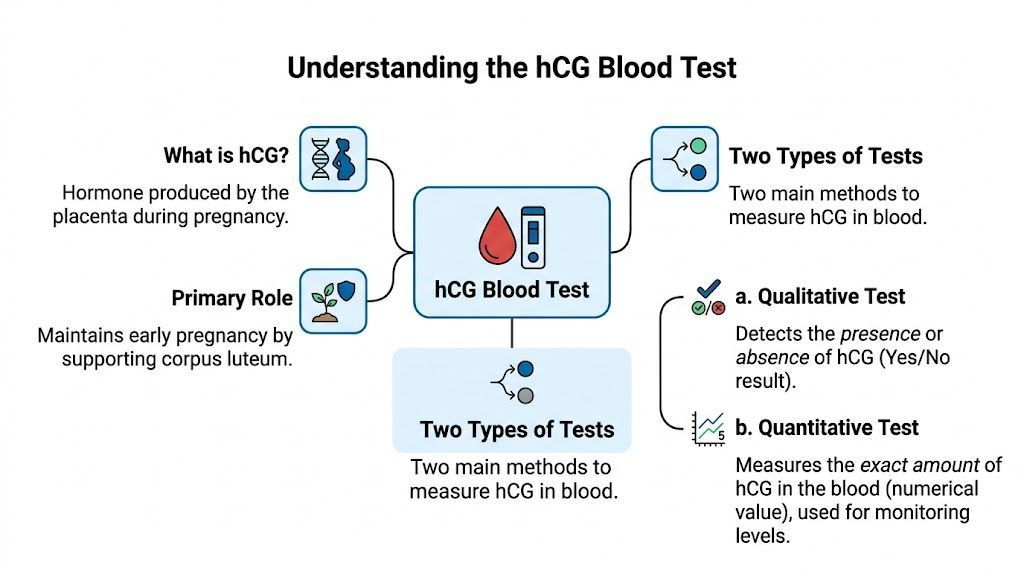
Light switch versus dimmer
A qualitative hCG test works like a light switch. It answers one question. Is hCG present or not?
A quantitative hCG test, often called beta hCG, works more like a dimmer. It measures how much hCG is in the blood. That number gives your provider more to work with, especially if they need to compare results over time rather than rely on a single yes-or-no answer.
This is why blood testing is often more clinically useful than a home urine test. A urine test is convenient screening. A blood test gives a clearer measurement, and the quantitative version adds detail that can guide medical decisions.
Why blood testing can offer more clarity
Blood testing detects hCG directly in the bloodstream, so it can pick up lower levels than many home tests. That added sensitivity is one reason clinicians use it when timing is early, symptoms are concerning, or a treatment plan depends on more than a simple positive or negative result.
For pregnant patients, the exact level can help a clinician decide whether repeat testing or imaging makes sense. For non-pregnant adults, the value is different. The test may be used to establish a baseline, check how the body is responding during care, or rule in or rule out questions before adjusting a hormone or weight-loss plan.
A quick comparison helps:
- Home urine test: Convenient, private, yes-or-no screening
- Qualitative blood test: Clinical yes-or-no confirmation
- Quantitative blood test: Exact measurement that can be followed over time
A short visual explanation may help if you're trying to picture the difference between these test types.
Practical rule: If your question is whether hCG is present, a simple test may answer it. If your question is how your body is changing over time, the quantitative blood test usually gives more useful information.
Why You Might Need an HCG Test
You might be searching for an hCG test after a faint home result, unexpected bleeding, a delayed period, or before starting a new treatment plan. In each of those situations, the question is the same. What is going on in my body, and is it safe to take the next step?
An hCG blood test often helps answer that question because it gives your clinician information that can change what happens next. Sometimes the purpose is to confirm a pregnancy. Sometimes it is to follow how an early pregnancy is progressing. In other cases, especially in a hormone or weight-management clinic, the test helps make sure a treatment plan starts on solid ground.

Pregnancy questions this test can help answer
For pregnancy-related care, clinicians usually order hCG testing when the answer needs more detail than a home urine test can provide. A blood test is often used when someone has:
- A faint or uncertain home test
- Pelvic pain or bleeding
- A need for early confirmation before a missed period
- A recent loss and a need to follow levels down
- A concern about ectopic pregnancy or miscarriage risk
In these moments, timing matters. So does the pattern over time. A single positive result can confirm that hCG is present, but repeat blood testing may help a clinician decide whether the pregnancy appears to be developing as expected or whether more evaluation is needed.
Why non-pregnant adults may need hCG testing
Many people are surprised to learn that hCG testing is not limited to pregnancy questions.
For non-pregnant adults, this test may be used before starting certain medications, before adjusting hormones, or while investigating symptoms that could have more than one explanation. It works like a safety check before a clinician changes treatment. If pregnancy is still biologically possible, ruling it out first helps your provider choose medications and doses more carefully.
That matters in wellness care. A person preparing for menopause treatment, testosterone care, or a medically supervised weight-loss plan may need hCG checked before the plan begins. A patient with fatigue, cycle changes, nausea, breast tenderness, or unexpected spotting may also need testing because those symptoms can overlap with hormone shifts, medication effects, and early pregnancy.
Public-facing testing pages often focus almost entirely on pregnancy. A broader overview from CVS MinuteClinic's pregnancy testing information reflects that gap and helps explain why many patients do not realize hCG testing can also support decisions in hormone-related care. If you are considering personalized hormone therapy options, this is one example of how lab work helps shape a safer, more individualized plan.
It can also be part of a wider medical evaluation
Clinicians may also order hCG testing in less common situations that have nothing to do with a routine pregnancy check. Since the 1970s, hCG measurement has been used during evaluation of conditions such as gestational trophoblastic disease and certain tumors.
That does not mean an abnormal result automatically points to a serious diagnosis. It means hCG is a useful clue. Like one piece of a puzzle, the result only makes sense alongside your symptoms, history, exam, and any other lab work your clinician orders.
Sometimes the most helpful hCG result is the one that rules out a concern and lets treatment proceed more safely.
Interpreting Your HCG Blood Test Results
You open your lab portal, see a number next to hCG, and immediately wonder what it means for your body, your treatment plan, or your next appointment. That reaction is completely normal.
An hCG result needs context. The same value can mean very different things depending on where you are in your cycle, whether pregnancy is possible, what symptoms you have, and whether your clinician is using the test to guide fertility care, hormone treatment, or a medical weight loss plan.
Typical pregnancy ranges
As noted earlier, pregnancy-related hCG ranges can vary widely by week. That wide spread is one reason clinicians avoid making big decisions from one number alone.
| Weeks from LMP | hCG Level Range (mIU/mL) |
|---|---|
| 3 weeks | 5 to 72 |
| 4 weeks | 10 to 708 |
| 5 weeks | 217 to 8,245 |
| 6 weeks | 152 to 32,177 |
| 7 weeks | 4,059 to 153,767 |
| 8 weeks | 31,366 to 149,094 |
| 9 weeks | 59,109 to 135,901 |
| 12 weeks | 27,107 to 201,165 |
| 16 weeks | 8,904 to 55,332 |
Reference values for people who are not pregnant are usually much lower. In general, non-pregnant women and men are expected to have very low levels, and postmenopausal women may have slightly higher baseline values than younger adults.
Patterns matter more than a single number
A single hCG result is like one frame from a movie. It gives information, but it does not show the full plot.
In early pregnancy, clinicians often look at how hCG changes over time. A repeat test may show a rise, a slower-than-expected increase, a plateau, or a drop. Each pattern points the evaluation in a different direction, but none of them should be read without your symptoms, exam findings, and sometimes ultrasound results.
A provider may interpret trends like this:
- Rising appropriately: Often reassuring in early pregnancy
- Rising more slowly: May lead to closer follow-up
- Falling: May suggest that a prior pregnancy event is resolving
- Higher than expected for the situation: May prompt more testing in the right clinical setting
This matters outside pregnancy too.
For a non-pregnant adult in hormone care, metabolic care, or a physician-guided weight loss program, an unexpected hCG result can change what happens next. It may affect whether a medication starts today, whether a cycle irregularity needs more evaluation, or whether your clinician pauses and confirms that the result fits the rest of the picture.
What low or borderline results can mean outside pregnancy
This is the part many patients are never told clearly.
A low positive hCG does not always equal a typical early pregnancy. In some adults over 40, especially during perimenopause, the body can produce small amounts of hCG from the pituitary gland. If that possibility is missed, a patient may be told to delay hormone treatment or wellness care for the wrong reason.
That is why clinicians read hCG alongside age, menstrual history, symptoms, medications, and other labs. Fatigue, sleep changes, mood shifts, irregular bleeding, and weight changes can overlap across early pregnancy, perimenopause, HRT adjustments, and metabolic conditions.
For men, an unexpected hCG elevation also deserves careful interpretation. The next step is not guesswork. The next step is making sure the result fits the clinical picture and deciding whether repeat testing or additional evaluation is needed.
If you want more plain-language explanations of lab testing in hormone and wellness care, the articles on Pause Medical's educational blog can help you prepare better questions for your visit.
A lab result starts the conversation. Your history, symptoms, and follow-up testing are what give that number meaning.
The HCG Testing Process What to Expect
The actual test is simple. Most of the anxiety comes from not knowing what the appointment will feel like or how long results will take.
Before the test
For an hCG blood test, fasting usually isn't required. In most cases, you can eat and drink normally unless your provider ordered other labs with different instructions.
It's also smart to tell your clinician about supplements and medications. The verified technical guidance notes that specimen handling matters, and Labcorp's hCG test methodology page describes the use of advanced immunoassay technology and notes that heparinized plasma can enhance diagnostic accuracy in some HRT or wellness settings by minimizing variability.
During the blood draw
The draw itself is routine. A staff member cleans the skin, places a small needle in a vein, collects the sample, and labels it for processing. The visit is usually brief, and individuals typically tolerate it well.
If you're nervous about blood draws, tell the person doing the collection. They can often help with positioning, hydration guidance, and simple comfort measures.
After the sample is collected
Direct-access and major lab options commonly report results in 1 to 2 business days through secure portals, based on the verified information provided for this article. The same verified data notes that pricing can vary by setting, with direct-pay options listed in the range of $36.95 to $161, depending on the lab and ordering pathway.
A few practical points help patients feel more prepared:
- Turnaround time: Many results return quickly, but exact timing depends on the lab workflow.
- Cost: Ask whether you're paying a clinic fee, a lab fee, or a bundled cash price.
- Follow-up: The value of the test comes from interpretation, especially if repeat testing is needed.
If you're comparing clinics, what to look for in a patient-centered practice can help you think beyond convenience and focus on communication, safety, and continuity.
Schedule Your HCG Blood Test at Pause Medical
You may be sitting in your car after work, searching for an hcg blood test near me because you want a clear answer before starting treatment. Maybe you are considering hormone therapy, reviewing a medical weight loss plan, or trying to make sense of fatigue, cycle changes, low libido, or other symptoms that have not felt like yourself. In those moments, convenience matters, but context matters too.
Pause Medical offers in-person care for people who want the test connected to a real medical plan. That matters for pregnancy screening, but it also matters for the broader wellness questions many adults bring to clinic visits. An hCG result can help a provider confirm that it is safe to begin or adjust HRT, interpret symptoms that overlap with hormone imbalance, and make informed decisions in medically supervised weight loss care.
The test itself is one data point. Its value comes from how it fits with the rest of your health picture.
What local care should feel like
A well-run visit should feel calm and organized. You should know where to go, what the blood draw is for, when results are likely to return, and who will explain them. Behind the scenes, many clinics use tools such as employee scheduling software for healthcare to reduce bottlenecks and keep appointments running on time.
If you want care close to home, you can review Pause Medical locations across Mississippi and choose the office that fits your schedule.
Why in-person review matters
Numbers can answer one question and raise three more.
For example, a low positive result may mean something very different in a person starting HRT than in someone trying to confirm pregnancy. A borderline value may need repeat testing, timing review, or a discussion about other hormone changes. For some non-pregnant adults, especially those in midlife care, the conversation after the lab draw is where the test becomes useful.
A thoughtful follow-up visit gives you space to ask simple, important questions. What does this number mean for me? Do I need another test? Does it change the timing of treatment? That kind of explanation helps patients make decisions with more confidence and less guesswork.
Good testing should lead to clear next steps.
Frequently Asked Questions About HCG Testing
Do I need to fast before an hCG blood test
Usually, no. Fasting is not required for this test unless their provider ordered other blood work that has separate instructions.
Is a blood test more accurate than a home urine test
Yes. The verified clinical data for this article notes that quantitative blood testing is more accurate and can detect much lower hCG levels than home urine testing, which is one reason clinicians use it when timing or precision matters.
Can supplements or medications affect results
They can. The verified technical guidance for this article notes that testing can be affected by handling issues and certain interferences, including biotin in specific assay settings. If you're taking supplements or prescription medications, tell your provider before the test.
Why would my doctor order an hCG test if I'm not trying to get pregnant
Because the result may affect what treatment is safe. Providers may use hCG testing to rule out pregnancy before starting hormone therapy, changing medications, or beginning a medically supervised weight loss plan. In some cases, the result also helps interpret symptoms that overlap with hormone imbalance.
What does a low positive result mean
It depends on the context. In some cases it can reflect very early pregnancy. In others, especially in women over 40, it may require repeat testing and clinical review because pituitary-related hCG can complicate interpretation.
Where should I go if I want both testing and follow-up
Choose a clinic that offers medical interpretation, not just specimen collection. If you'd like to speak with a provider about whether hCG testing fits your symptoms or treatment plan, you can contact
Pause Medical through their patient team.
If you're searching for clarity, not just a lab result,
Pause Medical offers in-person, patient-centered care for hormone health, medical weight loss, and wellness support across Mississippi. If you have symptoms that don't feel right, need pregnancy ruled out before treatment, or want a provider to explain what your hCG result means, schedule a consultation and get guidance specific to your health goals.