A Guide to Understanding Thyroid Function Tests
If you’ve ever felt exhausted for no reason, struggled with stubborn weight that won't budge, or dealt with frustrating mood swings, getting a handle on your thyroid function tests is a crucial first step. These simple blood tests are the key to understanding how well your body's master metabolic regulator—the thyroid gland—is really doing its job. A close look at these results can paint a surprisingly clear picture of your overall metabolic health.
At Pause Medical, our board-certified providers specialize in integrative medicine, looking beyond surface-level symptoms to uncover the root causes of issues like fatigue and weight gain. We understand the deep frustration that comes from feeling unwell, and we're here to provide the clarity and personalized care you deserve.
Why Your Thyroid Is the Key to Energy and Metabolism

That small, butterfly-shaped gland at the base of your neck holds incredible power over how you feel every single day. Think of it as the control panel for your body's entire engine. It produces hormones that set the pace for your metabolism, influence your heart rate, manage your body temperature, and even play a huge role in your mood and cognitive function.
When your thyroid is working as it should, you feel it—you have energy, your weight is stable, and your mind feels sharp. But if it starts producing too much or too little hormone, that delicate balance is thrown off, and the effects can ripple through your entire system.
The Widespread Impact of Thyroid Imbalances
Thyroid problems are incredibly common, but they're master impersonators. Their symptoms often look a lot like stress, the effects of aging, or even depression, which is why they so frequently fly under the radar. It's a massive diagnostic challenge that leaves millions feeling hopeless.
According to the American Thyroid Association, an estimated 20 million Americans have some form of thyroid disease. What's truly staggering is that up to 60% of them are unaware of their condition. They're just trying to get through the day with disruptive symptoms, completely unaware of the root cause.
At Pause Medical, we believe that you shouldn't have to guess about your health. We hear your struggles. So many of our patients come to us feeling defeated after being told their labs are "normal," yet they continue to struggle with issues that drag down their quality of life. Our board-certified providers are here to connect the dots between how you feel and what your lab results truly mean.
Symptoms That May Signal a Thyroid Imbalance
Recognizing the patterns in how you feel is the first step. This table helps you quickly identify if your symptoms align with common signs of thyroid dysfunction, guiding you toward a more informed discussion with your provider.
| Symptom | Commonly Associated With Hypothyroidism (Underactive) | Commonly Associated With Hyperthyroidism (Overactive) |
|---|---|---|
| Energy Levels | Persistent fatigue, sluggishness, needing excessive sleep | Feeling hyper, anxious, insomnia, heart palpitations |
| Weight | Unexplained weight gain, difficulty losing weight | Unexplained weight loss despite a normal or increased appetite |
| Mood | Depression, brain fog, poor memory and concentration | Anxiety, irritability, nervousness |
| Body Temperature | Feeling cold all the time, cold hands and feet | Feeling hot, excessive sweating, heat intolerance |
| Skin & Hair | Dry, brittle hair, hair loss (including eyebrows), dry skin | Thinning skin, fine, brittle hair |
| Digestion | Constipation, bloating | Frequent bowel movements, diarrhea |
| Muscles & Joints | Muscle aches, weakness, joint pain | Muscle weakness, trembling hands |
| Menstrual Cycle | Heavy, irregular, or prolonged periods | Lighter, shorter, or irregular periods |
If any of these sound familiar, it's not just "in your head." These are real, physical signs that something is off-balance. For many, the struggle with weight is particularly frustrating, and it's directly tied to how your hormones are functioning. You can explore our approach to medical weight loss to learn more about this connection.
Acknowledging these symptoms is an empowering move. It's the moment you stop accepting feeling unwell and start moving from confusion toward clarity and a personalized plan for feeling like yourself again.
Understanding the Story Your Thyroid Labs Are Telling

Getting your lab results back can feel like trying to decipher a secret code. That page of acronyms, numbers, and reference ranges doesn't mean much without context. But once you understand what each marker represents, the code becomes a clear story about your health.
Think of your thyroid system as a constant, delicate conversation between your brain and your thyroid gland. To truly understand what's going on, you have to listen to the whole conversation. The three most important voices are TSH, Free T4, and Free T3. A single TSH test, which is often all that’s ordered, is like hearing just one word from a long sentence—it simply doesn't give you the full picture.
TSH: The Brain's Signal to the Thyroid
Let's start with Thyroid Stimulating Hormone, or TSH. It’s a bit of a misnomer, because TSH isn't actually made by your thyroid gland. It's produced by the pituitary gland in your brain, and its only job is to tell your thyroid to get to work.
TSH acts like the thermostat for your body's energy. When your brain senses that thyroid hormone levels are dropping (the house is getting "cold"), it cranks out more TSH to tell the thyroid to turn up the heat. If it senses that hormone levels are too high (the house is "too hot"), it dials the TSH way down.
A high TSH is basically the brain shouting, "Hey, we need more hormone down here!" This is a classic sign your thyroid is struggling to keep up, pointing toward hypothyroidism. On the flip side, a very low TSH is the brain whispering, "Whoa, we have way too much," which often signals an overactive thyroid, or hyperthyroidism.
Free T4: The "Storage" Hormone
Once the thyroid gets the TSH signal, it primarily produces a hormone called Thyroxine (T4). Think of T4 as your body's main "storage" form of thyroid hormone. It circulates in your bloodstream, essentially warehoused until your body needs to put it to use.
It's crucial to have a healthy supply of T4 on hand, but on its own, T4 is inactive. It can't power your cells until it's converted into its active form.
This is why we measure "Free" T4. A large portion of the T4 in your blood is latched onto proteins, making it unavailable for use. The "free" portion is what's unbound and ready to be converted into the active hormone, T3. Measuring Free T4 gives us a much clearer idea of what your body actually has to work with.
Free T3: The "Active Energy" Hormone
This brings us to Triiodothyronine (T3), the real star of the show. This is the "active" hormone that does all the heavy lifting. When your cells need a metabolic boost, your body converts the inactive T4 into this powerful T3. It's T3 that docks onto receptors inside your cells to fire up your metabolism, regulate your body temperature, and keep your brain sharp.
You can think of Free T3 as the spark plugs for your engine. You can have a full tank of gas (plenty of T4), but if your spark plugs aren't working, you’re not going anywhere. This is a huge reason why so many people can have "normal" TSH and T4 levels yet still feel exhausted, cold, and foggy—their body isn't making the T4-to-T3 conversion properly.
Just like with T4, measuring "Free" T3 is essential. It tells us exactly how much of this potent, active hormone is available right now for your cells to use. Uncovering poor conversion is a common and often-missed piece of the puzzle that our board-certified providers at Pause Medical always investigate.
The Bigger Picture
If you’re struggling with thyroid symptoms, you are far from alone. The National Institutes of Health (NIH) provides extensive research and statistics about thyroid conditions highlighting their prevalence. The autoimmune condition Hashimoto's thyroiditis is the leading cause of an underactive thyroid in the United States, affecting a significant portion of the population.
Understanding these three key players—TSH, Free T4, and Free T3—is the first step to truly decoding your thyroid health. They operate in a dynamic feedback loop, and looking at them together provides the clarity needed to finally connect your symptoms to what’s really happening inside your body. This is how we begin to build a personalized plan to get your energy and your life back on track.
Looking Deeper with Advanced Thyroid Markers
Sometimes, the standard thyroid panel—TSH, Free T4, and Free T3—just doesn't tell the whole story. If those labs come back looking "normal" but you still feel exhausted, mentally foggy, and just plain off, it’s a sign we need to dig deeper. That's where advanced markers come in. These tests can uncover the hidden issues and underlying stressors that are keeping you from feeling like yourself.
At Pause Medical, our board-certified providers don’t just look at surface-level numbers. We believe in a thorough investigation to get to the root cause of your symptoms, which is the only way to create a truly personalized treatment plan. Two of the most revealing advanced markers we look at are Reverse T3 and thyroid antibodies.
Reverse T3: The Body's Emergency Brake
Think of your active T3 hormone as the gas pedal for your metabolism—it keeps everything running. Now, imagine your body has an emergency brake it can pull during times of intense stress. That's Reverse T3 (rT3).
When your body is under significant physiological strain—whether from a serious illness, extreme dieting, chronic inflammation, or even major emotional distress—it goes into survival mode. Its top priority becomes conserving energy. To do this, it diverts the conversion of T4 away from the active T3 and creates Reverse T3 instead. This molecule is a mirror image of T3; it fits into the same receptors on your cells, but instead of turning them on, it blocks them. It’s like putting a key in a lock that fits but won't turn.
This is a critical point: You can have perfectly normal TSH and Free T4 levels, but if your body is churning out high amounts of Reverse T3, you'll still have all the classic symptoms of hypothyroidism. Your cells are literally being starved of the active hormone they need.
This is an incredibly common, yet frequently missed, reason why so many people continue to feel unwell despite being told their thyroid is fine. Finding high rT3 levels completely changes the conversation. It shifts the focus from just giving more hormone to figuring out why your body is hitting the brakes in the first place.
Thyroid Antibodies: Identifying an Autoimmune Attack
The other crucial piece of the thyroid puzzle is checking for thyroid antibodies. Your immune system’s job is to attack foreign invaders like viruses and bacteria. But in an autoimmune condition, it gets its wires crossed and starts attacking your own healthy tissue.
When it comes to the thyroid, there are two key antibodies we need to measure:
- Thyroid Peroxidase Antibodies (TPOAb): These antibodies go after an enzyme that's essential for making thyroid hormones. Their presence is the classic sign of Hashimoto's Thyroiditis, which is the #1 cause of hypothyroidism in the United States.
- Thyroglobulin Antibodies (TgAb): These attack thyroglobulin, a protein your thyroid uses as a storage tank for its hormones. These are also frequently elevated in Hashimoto's.
Finding these antibodies tells us that your thyroid problem isn't just a simple hormone shortage—it's an active autoimmune assault on the gland itself. Research shows a huge percentage of hypothyroidism cases are autoimmune, and knowing this is a complete game-changer for how we approach treatment.
When we know there's an autoimmune component, effective care has to go beyond simply replacing hormones. We also have to work on calming the immune system, reducing inflammation throughout the body, and pinpointing the triggers that are fanning the autoimmune flames. Our integrative approach to thyroid disease state management is built on this very principle. Without this deeper understanding, you’re just stuck in a frustrating cycle of chasing symptoms instead of truly getting well.
Making Sense of Your Thyroid Lab Results
Getting your lab report can feel like trying to read a foreign language. It's just a page of numbers and acronyms. But once you learn what to look for, those numbers start telling a story—your story. It’s the difference between staring at data and finally understanding the message your body has been trying to send.
Let's walk through some of the most common patterns we see in thyroid labs. By connecting these results to the symptoms you're actually feeling, you can start to piece everything together and have a much more informed conversation with your doctor.
Classic Hypothyroidism: The Loud and Clear Signal
This is the most straightforward pattern of all. When your thyroid gland simply isn't making enough hormone, your brain's pituitary gland starts to "shout" at it, demanding more production.
This hormonal shouting match shows up on your labs as:
- High TSH: The brain is working overtime to stimulate a sluggish thyroid.
- Low Free T4: Your thyroid isn't responding, so it fails to produce enough storage hormone.
- Low Free T3: Without enough T4 to convert, your active hormone levels drop, too.
This trio of results almost always lines up with the classic symptoms of an underactive thyroid: deep fatigue, stubborn weight gain, brain fog, and feeling cold all the time. It’s a clear sign that your body's metabolic engine is running on fumes.
Subclinical Hypothyroidism: The Subtle Warning Sign
This is one of the most common—and most frequently dismissed—patterns. It’s a sign that your body is struggling to keep things in balance, and the strain is beginning to show. You may even be told your labs are "mostly normal."
Here’s what it typically looks like:
- High or High-Normal TSH: Your brain is already raising its voice to keep the thyroid going.
- Normal Free T4 & Free T3: Your thyroid is just barely managing to keep up, but it's under duress.
This is a critical early warning. Even though your T4 and T3 levels are still in the "normal" range, that elevated TSH is a huge red flag that your system is under stress. This pattern often explains those frustrating early symptoms, like nagging fatigue, trouble losing that last 10-15 pounds, or subtle changes in your hair and mood.
At Pause Medical, we take this pattern very seriously. It gives us a window to step in and offer support before you slide into full-blown hypothyroidism, potentially saving you years of feeling unwell.
This is exactly why we sometimes need to look beyond the basic panel. When symptoms persist despite "normal" labs, it's our cue to investigate deeper for things like chronic stress or an autoimmune response.
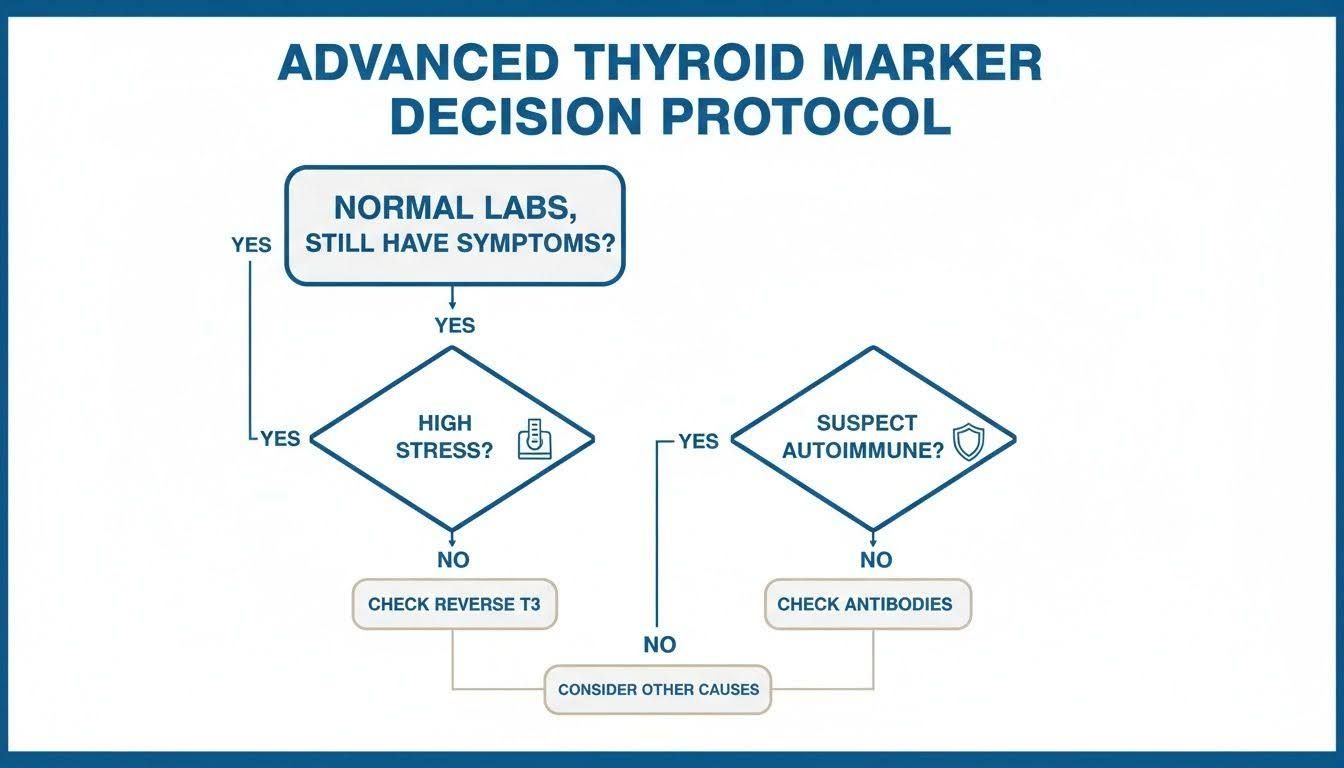
The bottom line is simple: if you still feel "off," your symptoms deserve a closer look, even if the first round of tests doesn't give a clear answer.
The Conversion Problem: When T4 Can't Become T3
This might be the most maddening and overlooked pattern of them all. You can have plenty of the "storage" hormone (T4), but if your body can't convert it into the "active" energy hormone (T3), you will still feel every bit as hypothyroid.
The lab signature for this issue is:
- Normal TSH: The brain thinks everything is fine because it sees plenty of T4.
- Normal Free T4: Your thyroid is making enough storage hormone.
- Low Free T3: The crucial conversion process is failing somewhere along the line.
Think of it like having a full tank of gas (T4) but faulty spark plugs. Your engine just won't start. Patients with this pattern often feel completely invalidated because their standard TSH test comes back looking perfect. Yet they're struggling with significant symptoms because their cells are being starved of the active T3 they need to create energy.
Things like chronic stress, inflammation, or even simple nutrient deficiencies can sabotage this vital conversion process. This is exactly why a one-size-fits-all approach to thyroid care so often fails.
Common Thyroid Lab Result Patterns at a Glance
To make this a bit easier to visualize, here’s a quick summary table. Think of it as a cheat sheet for understanding what different combinations of thyroid lab results might mean.
| Pattern Name | TSH Level | Free T4 Level | Free T3 Level | What It May Indicate |
|---|---|---|---|---|
| Classic Hypothyroidism | High | Low | Low | The thyroid gland is underactive and not producing enough hormone. |
| Subclinical Hypothyroidism | High or High-Normal | Normal | Normal | The thyroid is starting to struggle; an early warning sign. |
| Poor T4 to T3 Conversion | Normal | Normal | Low | The body isn't effectively activating the available thyroid hormone. |
| Classic Hyperthyroidism | Low | High | High | The thyroid gland is overactive and producing too much hormone. |
| Central Hypothyroidism | Low or Normal | Low | Low | A rare issue where the pituitary gland in the brain isn't signaling the thyroid correctly. |
This table can help you spot potential red flags in your own lab work, giving you a starting point for a more productive discussion with your healthcare provider.
Recognizing these distinct patterns is the first real step toward getting an accurate diagnosis. More importantly, it’s the key to getting the right kind of support to finally feel like yourself again. To see how our providers build these kinds of nuanced plans, you can learn more about our philosophy on personalized hormone therapy.
How Other Hormones and Lifestyle Factors Affect Your Thyroid
Your thyroid doesn’t work in isolation. It’s a key player in a complex web of hormones and body systems that are constantly talking to each other. When one part of that system is out of balance, it can throw everything else off, which is why just looking at the thyroid by itself often misses the full story.
At Pause Medical, our board-certified providers see you as a whole person, not just a set of lab results. We know that getting your energy and vitality back means looking at all the interconnected pieces, from chronic stress to other hormone imbalances, using an integrative medicine approach.
The Adrenal Stress Connection
Chronic stress is one of the biggest enemies of a healthy thyroid. When you’re constantly running on empty, your adrenal glands produce a steady stream of the stress hormone cortisol. While a little bit of cortisol is perfectly normal, persistently high levels can sabotage your thyroid in a few critical ways.
The biggest issue is that high cortisol blocks the conversion of the inactive T4 hormone into the active T3 hormone that your cells actually use. It’s your body’s way of hitting the emergency brake, shunting production toward Reverse T3 instead. This leaves you with all the classic hypothyroid symptoms—like fatigue and brain fog—even when your T4 levels look normal.
Think of it this way: your adrenals and thyroid are business partners. If the adrenals are always in crisis mode (from high stress), they start hoarding resources and tell the thyroid to slow everything down to conserve energy. This is exactly why managing your stress is non-negotiable for any successful thyroid treatment plan.
How Sex Hormones and Insulin Play a Role
It's not just your stress levels. The delicate balance of your sex hormones and your overall metabolic health are also deeply tied to your thyroid function. Understanding how these systems interact is a core part of our approach to integrative medicine and wellness.
- Estrogen Imbalances: If your estrogen levels are too high compared to your progesterone—a common condition known as "estrogen dominance"—it can raise the amount of a protein called thyroid-binding globulin (TBG). This protein acts like a sponge, soaking up thyroid hormones in your bloodstream and preventing your cells from using them. So, you might be making plenty of hormones, but they're all tied up and can't get to where they need to go.
- Insulin Resistance: This is a metabolic issue where your cells stop responding properly to insulin, and it’s a frequent precursor to type 2 diabetes. The inflammation and hormonal chaos it creates can directly interfere with thyroid function and make that all-important T4-to-T3 conversion even less efficient. This is a big reason why thyroid problems and stubborn weight gain so often go hand-in-hand.
This web of interconnected factors is why simply taking a thyroid pill often isn’t the complete solution. A helpful resource for understanding how to support your body's other systems is this guide to hormone imbalance supplements. Lasting wellness comes from a holistic plan that addresses stress, nutrition, and your other hormonal systems to truly rebuild your health from the ground up.
Your Next Steps to Taking Control of Your Thyroid Health
Figuring out your thyroid labs isn't just about staring at a bunch of numbers on a lab report. It’s about finally connecting the dots between how you’ve been feeling and what’s actually happening inside your body. By now, you get it: a full thyroid panel is non-negotiable, "normal" on a lab sheet doesn't always feel normal, and your thyroid is deeply connected to, well, everything.
Here’s the most important thing to remember: You do not have to keep struggling with that unexplained fatigue, stubborn weight, or constant brain fog. Getting back to feeling vibrant and energized is absolutely possible. The journey starts by tuning into your body's signals and finding a medical team that will truly listen.
Preparing for Your Next Blood Test
To get a truly accurate picture of your thyroid function, a little prep work goes a long way. Small details can have a surprisingly big impact on your results, and we want to make sure your treatment plan is based on the most reliable data possible.
Here are a few practical tips to discuss with your doctor before your next appointment:
- Timing Your Medication: Chat with your doctor about whether to take your thyroid medication before or after your blood is drawn. Most of the time, it's best to test before your daily dose to avoid a temporary surge in hormone levels that could skew the results.
- Hold the Biotin: High doses of biotin, a popular B-vitamin found in many hair and nail supplements, can interfere with the lab tests used to measure thyroid hormones. It's a good idea to stop taking it for at least 48-72 hours before your blood draw.
- Keep Calm: Believe it or not, high-stress situations can temporarily nudge your TSH levels. You can’t avoid all of life's stressors, but if possible, try to schedule your test for a day that feels relatively calm.
Your lab results provide the data, but your symptoms tell the story. The real goal of testing is to find the objective evidence that validates how you feel, clearing the way for a treatment plan that actually works for you.
As you think about your path forward, remember that targeted support from nutrition and supplements can also be a game-changer. For anyone looking to learn more, resources that cover the Best Supplements for Thyroid Health can offer some great insights to complement your doctor's advice.
Partner with an Expert Who Listens
You’ve already done the hard work of educating yourself. Now, let us help you take the next step. Stop trying to solve this complex puzzle on your own.
Our board-certified providers at Pause Medical specialize in a patient-first approach. We dig deep to find the root cause of your symptoms and build integrative treatment plans that go beyond just prescribing a pill. We’re here to create a personalized strategy that helps you finally feel like yourself again.
If you’re ready to trade confusion for clarity, we invite you to schedule a consultation with our medical team today.
Your Thyroid Testing Questions, Answered
When you're dealing with thyroid health, the practical details of testing can feel overwhelming. Let's walk through some of the most common questions we hear, so you can go into your next lab test feeling prepared and confident.
How Often Do I Need to Get My Thyroid Checked?
There’s no one-size-fits-all answer here; it really depends on where you are in your health journey. If your symptoms are under control and you’re on a stable medication dose, checking in once a year might be all you need.
But if you're just starting hormone therapy, adjusting your dose, or if those familiar symptoms start creeping back in, we'll need to check more often. In those active phases, testing every 6 to 8 weeks is pretty standard until we find that sweet spot where your levels are stable and you're feeling great again. At Pause Medical, we'll map out a testing schedule that makes sense for you personally.
Do I Have to Fast for My Thyroid Blood Test?
For the main thyroid hormones we look at—TSH, Free T4, and Free T3—you typically don't need to fast. What you had for breakfast won't really move the needle on those results.
However, we often look at the bigger picture, which might include tests for things like fasting glucose, insulin, or cholesterol. If your blood work includes any of those, then yes, you'll need to fast beforehand. We always make sure to give you crystal-clear instructions before any lab visit, so you'll know exactly what to do.
Should I Take My Thyroid Medication Before My Blood Draw?
This is a fantastic and very important question. To get the truest picture of how your body is using its thyroid hormone, we almost always advise you to get your blood drawn before you take that day's dose.
Why? Because taking your medication right before the test can create a temporary surge in your T4 and T3 levels. This can skew the results, making it look like your dose is too high when it's actually just right. A good habit is to bring your medication with you to the lab and take it right after they’ve drawn your blood. Of course, always double-check this plan with your Pause Medical provider.
Medical Disclaimer: The information in this article is for educational purposes only and is not intended as a substitute for professional medical advice, diagnosis, or treatment. Always seek the advice of your physician or other qualified health provider with any questions you may have regarding a medical condition. Never disregard professional medical advice or delay in seeking it because of something you have read in this article. All treatments are personalized and performed under the supervision of our board-certified medical team.
At Pause Medical, we know that feeling empowered starts with having clear answers. If you have more questions or you're ready to partner with a provider who truly listens, we're here for you.
Take the first step toward clarity and book your consultation at pausemedical.org