Can Low Testosterone Cause Sleep Problems and How to Fix It
Tired of tossing and turning, only to drag yourself out of bed feeling like you haven't slept at all? If you're wondering, "can low testosterone cause sleep problems?" the answer is a resounding yes. This isn't just about feeling a little groggy; it's a complex hormonal issue that can directly sabotage your rest and recovery. At Pause Medical, our board-certified providers specialize in diagnosing and treating these root-cause issues to help you reclaim your energy and vitality.
The Hidden Link Between Testosterone and Your Sleep

If you’re constantly fighting fatigue even after spending eight hours in bed, an underlying hormone imbalance could be the real culprit. Many men get caught in a frustrating catch-22: low testosterone disrupts their sleep, and that poor sleep then causes testosterone levels to tank even further. It’s a vicious cycle that can drain your energy, sour your mood, and take a toll on your overall health.
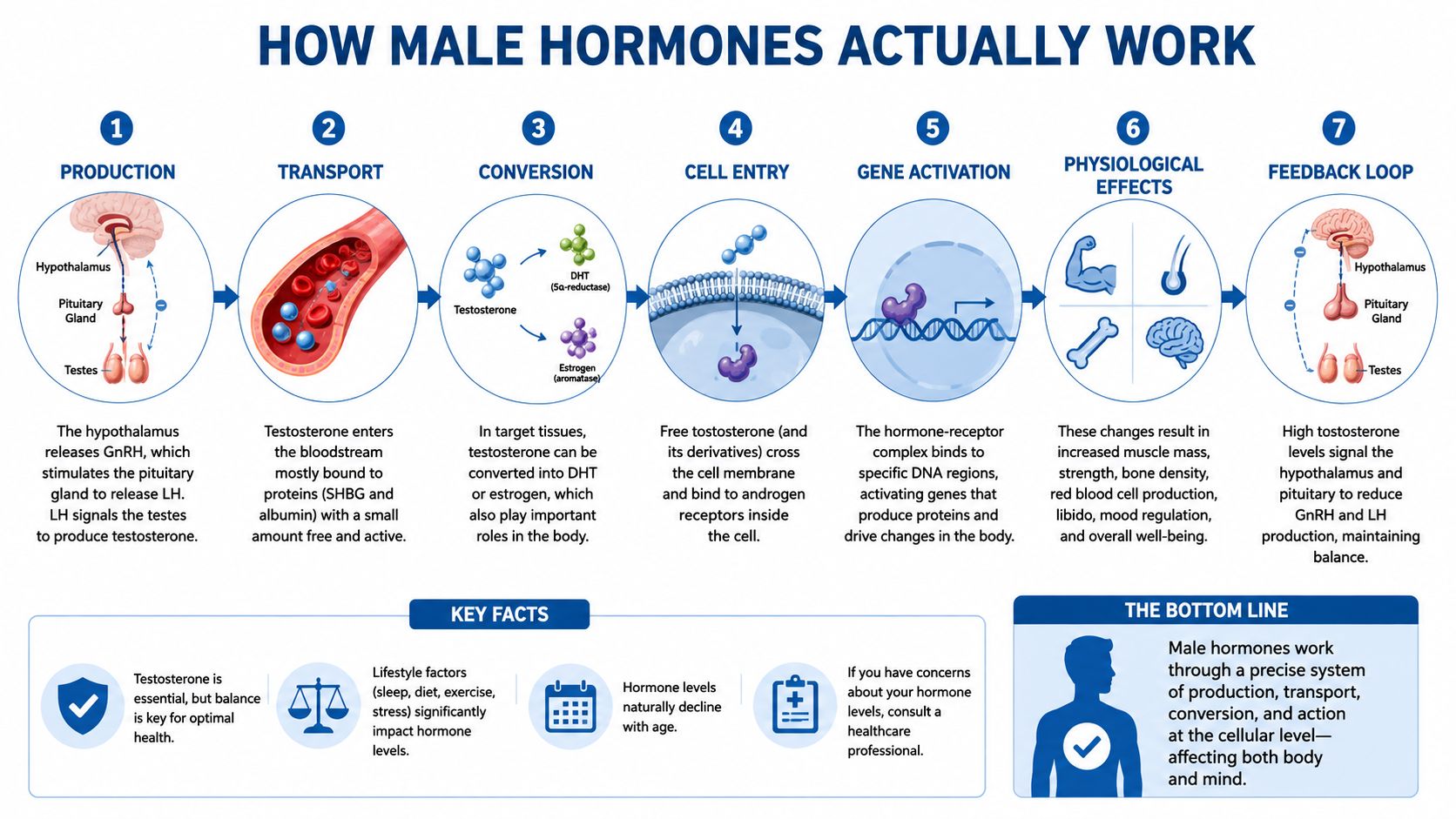
Testosterone, a key hormone in both men and women, plays a vital role in regulating many of your body's essential systems, including your sleep-wake cycle. When testosterone levels are optimal, your brain chemistry supports falling asleep, staying asleep, and getting deep, restorative rest. But when your testosterone is low, it can lead to fragmented, unsatisfying sleep, leaving you exhausted.
Why Your Hormones Matter for Sleep
This connection isn't just a hunch—it's backed by solid medical research. Studies show that poor sleep quality plagues a significant percentage of men with clinically low testosterone, turning what should be a peaceful recharge into a nightly struggle. Testosterone plays a crucial role in managing the neurotransmitters that govern our circadian rhythms—the body's internal clock that tells us when to feel sleepy and when to be alert.
At Pause Medical, we understand how frustrating these symptoms are. Patients often come to us feeling exhausted and dismissed. Our goal isn't to put a band-aid on the fatigue but to find and treat the root cause through a personalized, integrative medicine approach, giving you a clear path back to feeling your best.
To give you some immediate clarity, here are some straightforward answers to the questions we hear most often from our patients.
Quick Answers to Your Questions About Low T and Sleep
| Common Question | The Short Answer |
|---|---|
| Does low testosterone actually cause insomnia? | Yes, it can. Low T disrupts the hormonal signals your brain needs for deep, restorative sleep, making it harder to fall and stay asleep. |
| Is it the low T or am I just getting older? | It's often the low T. While sleep patterns can change with age, a significant drop in sleep quality is a classic sign of andropause (male menopause), a hormonal imbalance that is treatable. |
| If I fix my sleep, will my testosterone go up? | It can help, but it may not be enough. Improving sleep hygiene is crucial, but if your T levels are already clinically low, you'll likely need medical intervention like hormone replacement therapy to break the cycle. |
| What's the biggest sleep problem linked to low T? | Sleep apnea is a major one. Low testosterone is strongly linked to obstructive sleep apnea (OSA), which fragments sleep and starves your body of oxygen, further lowering T levels. |
Recognizing that your sleep problems might be hormonal is the first step toward getting effective relief. Instead of just chasing away the exhaustion with caffeine, we focus on rebalancing the underlying system. Through a personalized, evidence-based approach that combines advanced diagnostics with expert medical care, we can help you break the cycle for good. Our commitment to your preventative wellness and vitality means you don't have to figure this out alone. Lasting, compassionate care is closer than you think.
How Low Testosterone Disrupts Your Nightly Rest
Think of a good night's sleep as a carefully constructed building, with a solid foundation (falling asleep), strong framework (deep sleep), and a protective roof (REM sleep). This whole process is often called sleep architecture. When testosterone levels are low, it's like a storm hitting that construction site every single night, weakening the entire structure from the ground up.
This hormonal imbalance directly messes with your brain's ability to move through the essential stages of sleep. It's particularly disruptive to two key phases: the deep, slow-wave sleep you need for physical repair, and the REM sleep that’s vital for processing memories and emotions. When these stages get cut short or fragmented, you can spend eight hours in bed and still wake up feeling like you haven't slept a wink.
The Breakdown of Your Sleep Cycle
With low testosterone, the entire carefully orchestrated sleep process can start to crumble. You might find yourself dealing with a whole host of issues that sabotage your rest, each one a direct result of this hormonal shortfall.
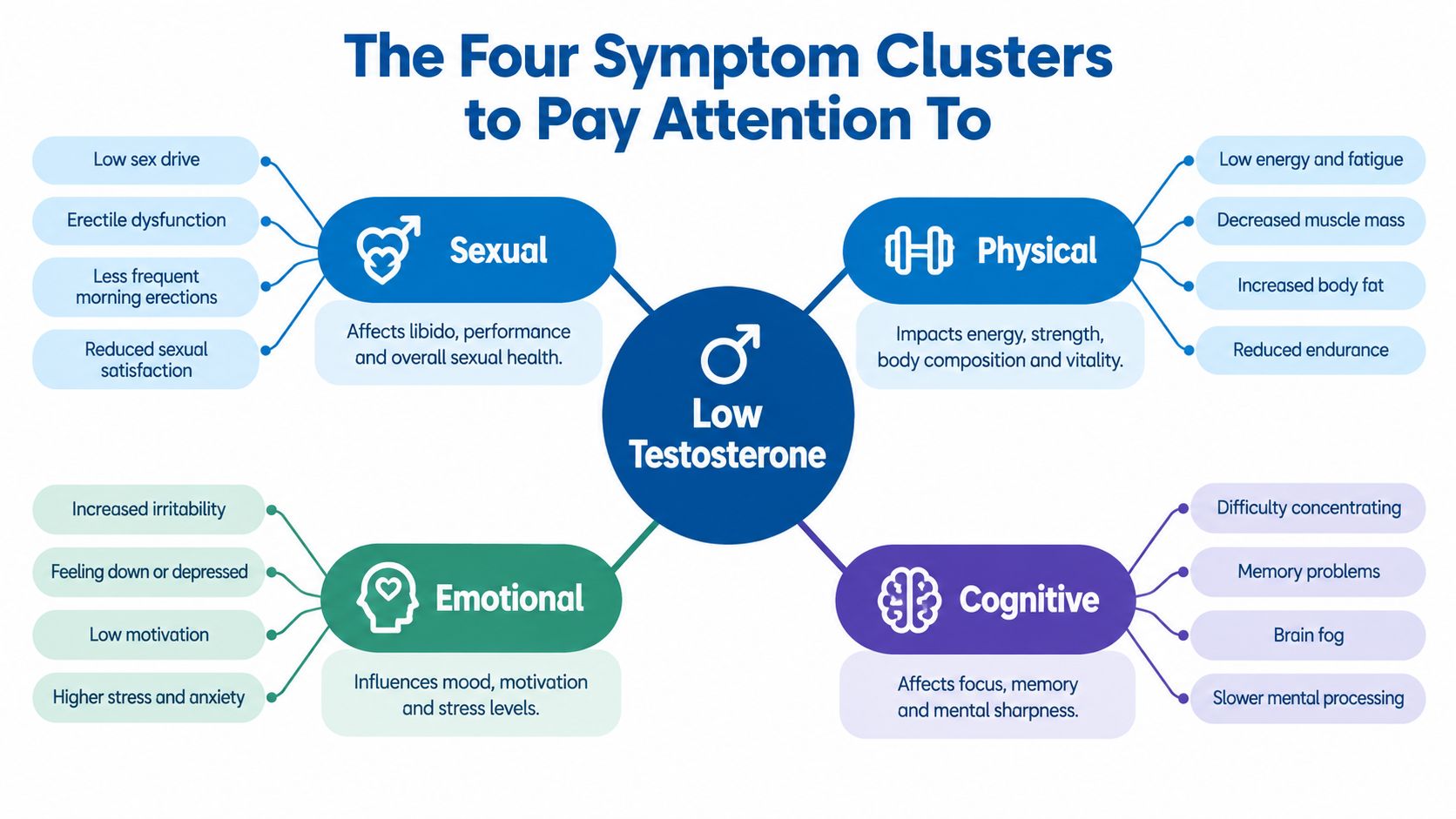
Common sleep-related symptoms of low testosterone often include:
- Difficulty Falling Asleep (Sleep Onset Insomnia): You lie awake, your mind racing, unable to switch off. Low T can throw off the calming brain chemicals you need to drift into sleep.
- Waking Up Frequently: You find yourself waking up multiple times during the night for no clear reason. This is a tell-tale sign of fragmented sleep.
- Morning Exhaustion: You wake up groggy, unrefreshed, and just plain drained, even after what felt like a full night in bed. This points to a lack of restorative deep sleep.
In some cases, men also start experiencing night sweats. These episodes can be intense enough to drench your sheets and jolt you awake, shattering your already fragile sleep and making a full night of rest feel completely out of reach.
The Vicious Cycle of Sleep Loss and Low T
Here’s the really frustrating part: the connection between sleep and testosterone is a two-way street. It creates a vicious cycle that’s incredibly tough to break on your own. Low testosterone disrupts your sleep, but poor sleep also tanks your testosterone production.
Your body produces the most testosterone during deep sleep. When that sleep is constantly broken, your body never gets the uninterrupted time it needs to manufacture hormones. This pushes your T levels even lower, which in turn makes the next night's sleep even worse.
This isn't just a theory; it’s a well-documented physiological fact. A landmark 2011 study from the University of Chicago, for instance, took a group of healthy young men and limited their sleep to just five hours a night for one week. The result? Their testosterone levels plummeted by a staggering 10-15%—effectively aging them a decade or more from a hormonal standpoint. This powerful research shows just how much even short-term sleep deprivation can hammer your endocrine system.
This damaging feedback loop can also have serious long-term health consequences. Chronic sleep loss and low testosterone are tied to a host of other health problems, including metabolic syndrome, diabetes, and heart disease. Getting to the bottom of these interconnected issues is a core part of our comprehensive disease state management services, where we focus on your total health picture. By identifying the root cause, we can build a plan to restore both your hormonal balance and your ability to get the deep, refreshing sleep you need to thrive.
The Dangerous Link Between Sleep Apnea and Low Testosterone
While things like night sweats and broken sleep are frustrating, one of the most serious health issues tied to low testosterone is Obstructive Sleep Apnea (OSA). This goes far beyond simple snoring. OSA is a medical condition where your breathing literally stops and starts again and again, all night long. These pauses can last for just a few seconds or even up to a minute, forcing your body out of deep, restorative sleep as it gasps for air.
Picture your airway like a soft, flexible tube. When you fall asleep, the muscles in your throat naturally relax. For someone with OSA, however, these muscles relax too much. This causes the airway to become narrow or even collapse completely, blocking air from getting to your lungs. Your brain senses the dangerously low oxygen levels and sends an emergency signal to wake you up just enough to take a breath. This can happen hundreds of times a night, often without you ever being fully conscious of it.
The Two-Way Street of Hormonal Decline
The connection between low testosterone and sleep apnea is a particularly nasty one because it’s a two-way street. One condition can easily trigger the other, creating a downward spiral that makes both problems worse over time.
Here’s a breakdown of how this vicious cycle works:
- Sleep Apnea Tanks Your Testosterone: The constant oxygen deprivation caused by OSA puts a tremendous amount of stress on your system. This chronic stress elevates cortisol, which suppresses the brain's signals for testosterone production.
- Low Testosterone Makes Sleep Apnea Worse: Testosterone plays a key role in maintaining muscle tone throughout your body—including the small muscles that hold your airway open while you sleep. When testosterone levels drop, these muscles weaken, making an airway collapse much more likely.
This diagram shows just how intertwined low T and poor sleep can become, feeding into one another.
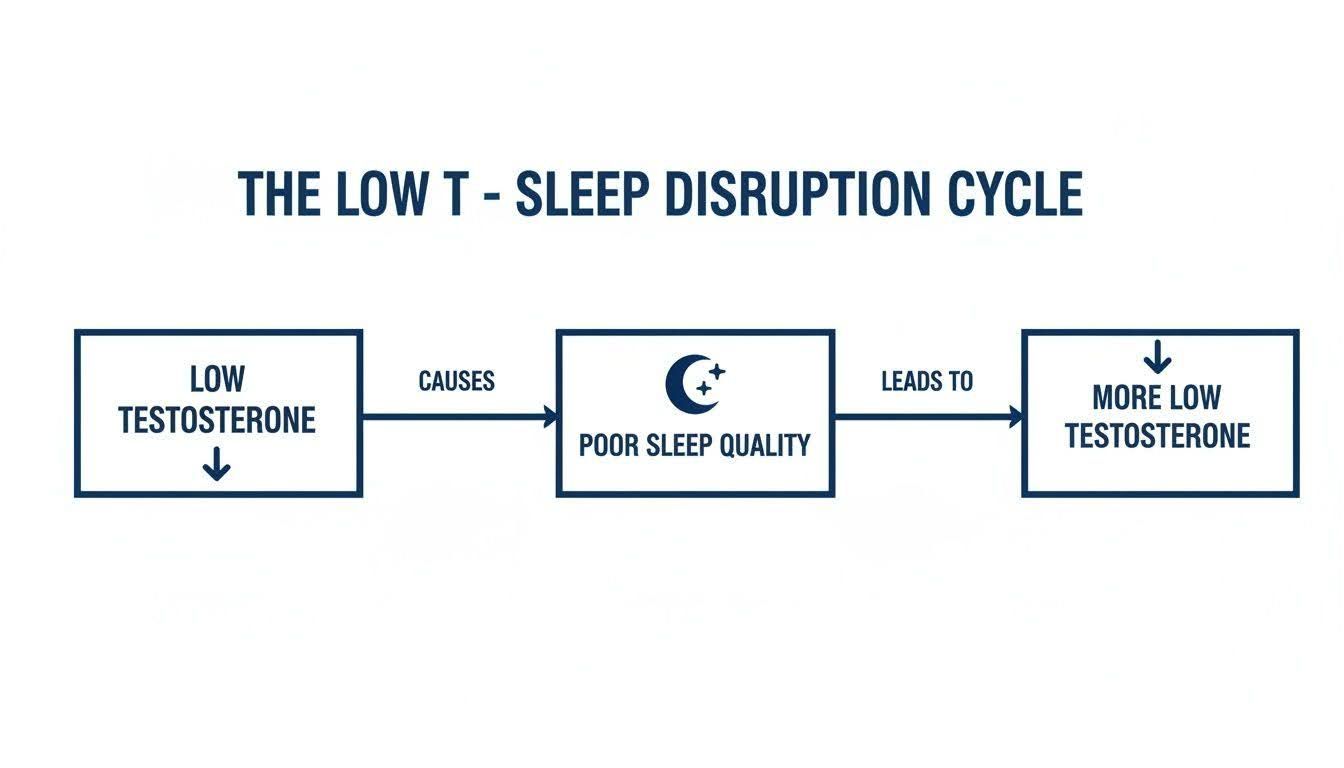
This cycle of hormonal imbalance and sleep disruption can quickly get out of hand, affecting far more than just your energy.
Why This Vicious Cycle Is So Damaging
If you don't intervene, this destructive feedback loop can significantly raise your risk for other serious health problems. The constant strain from oxygen deprivation and fragmented sleep puts an enormous burden on your heart, contributing to high blood pressure, heart attacks, and strokes.
At Pause Medical, our board-certified providers are trained to see these interconnected patterns. We don't just look at a low testosterone number in isolation. We investigate why it's low, which often means screening for conditions like sleep apnea to address the complete health picture.
On top of that, both low testosterone and sleep apnea are strongly linked to weight gain and metabolic dysfunction. Low T often leads to an increase in body fat, especially around the stomach. This excess weight, in turn, is one of the biggest risk factors for developing or worsening sleep apnea. If you’ve been struggling to lose weight no matter what you try, this "hormone-sleep-weight" trifecta could very well be the root cause. You can learn more about how we approach this through our medical weight loss programs, which may include options like GLP-1 medications.
This entanglement is exactly why a comprehensive, integrative approach is so critical. Trying to fix low testosterone without addressing the underlying sleep apnea is like patching only one hole in a leaky bucket—the problem won't go away. If sleep apnea is part of your health picture, it's worth exploring all your options. For example, some people find success when they learn how to treat sleep apnea without CPAP as part of a more holistic plan. At Pause Medical, we focus on creating personalized plans that tackle all contributing factors to give you a real, lasting solution.
How to Get a Definitive Diagnosis
You can't just guess if low testosterone is the culprit behind your poor sleep. Getting to the bottom of it requires a medical diagnosis from a qualified provider. The process starts with a comprehensive consultation and involves a few key steps to see the whole picture.
The very first thing we need is solid data, and that means a comprehensive blood test. This is the only way to accurately measure your hormone levels and know for sure if an imbalance is part of the problem. It gives us an objective starting point for your personalized treatment plan.
What Your Lab Results Actually Mean
When we run a hormone panel, we’re looking at several key markers, including:
- Total Testosterone: This is a measure of all the testosterone in your bloodstream. Think of it as the total amount of fuel in the tank.
- Free Testosterone: This is the testosterone that's unbound and actively available for your body to use. This number is often the most important one, as it reflects the hormone that’s actually working to regulate your energy, mood, and sleep.
While there are established "normal" ranges for these levels, it's critical to see them as just a guide. What’s optimal for one person isn't necessarily optimal for another. At Pause Medical, our board-certified providers don’t just treat a number on a lab report. We listen to your symptoms and focus on finding the right hormonal balance for you.
Putting the Pieces of the Puzzle Together
Once we have your lab results, we'll sit down and talk through everything you're experiencing. Be specific. Don't just say you're tired; tell us how your sleep is being affected. Are you struggling to fall asleep? Waking up multiple times a night? Dealing with night sweats? These details help us connect the dots between your symptoms and your hormones.
This is also where we'll screen for related conditions, especially obstructive sleep apnea (OSA). The link between low T and sleep apnea is so strong that we have to consider it. If your symptoms point toward OSA, the next step is often a sleep study, which is the definitive way to diagnose breathing issues during sleep.
Getting the right diagnosis is about piecing together the entire puzzle—your lab work, your symptoms, and other potential health factors. A definitive answer can only come from a comprehensive medical evaluation that views you as a whole person, not just a set of symptoms.
The relationship between sleep and hormones is a two-way street. We know that poor sleep can tank your testosterone levels. A large national health survey, for instance, found a significant statistical link between shorter sleep duration and lower testosterone levels in men. You can read the full research findings on sleep duration and hormone levels to see the data for yourself. This shows exactly why improving your sleep is a non-negotiable part of any plan to optimize your hormones.
At Pause Medical, we guide you through this process from start to finish. It all begins when you schedule a consultation with our team. You’ll meet with an experienced, board-certified provider who will perform a thorough evaluation, give you a clear diagnosis, and create a personalized plan to get you back to feeling your best.
Getting Back to Restful Nights: Your Treatment Options
Once you have a clear diagnosis, the most important question is, "What can I actually do about this?" If low testosterone is behind your sleep problems, the good news is that there are clear, effective paths forward to reclaim your sleep and get your energy back.
The answer isn't a single magic bullet. Instead, it's about building a personalized, smart strategy that addresses the real root of the problem—not just the symptoms. At Pause Medical, our board-certified providers work with you to combine foundational lifestyle habits with targeted medical therapies for results that truly last.
Building a Strong Foundation First
Before we even talk about medical treatments, we always start with the fundamentals. Think of these lifestyle habits as preparing the ground for better health. They create the ideal internal environment for your body to regulate hormones and get quality sleep.
- Fueling Your Hormones: Your diet is a powerful lever for hormonal health. Focusing on lean proteins, healthy fats, and whole-food carbs gives your body the raw materials it needs to produce testosterone. On the flip side, processed junk and sugary foods can throw your hormones further out of whack.
- Moving with Purpose: Regular, strategic exercise is one of the best things you can do. A combination of resistance training (like lifting weights) and cardio has been proven to help boost testosterone and deepen sleep. Consistency is far more important than pushing yourself to the point of exhaustion.
- Taming Your Stress: When you're constantly stressed, your body is flooded with cortisol, a hormone that directly gets in the way of testosterone production. Simple practices like deep breathing, meditation, or even a quiet walk can significantly lower cortisol, giving your testosterone a chance to recover.
For many, these changes make a world of difference. But sometimes, especially if an underlying issue like sleep apnea is at play, they aren't quite enough to break the cycle on their own.
Addressing Underlying Conditions Like Sleep Apnea
If your evaluation reveals obstructive sleep apnea (OSA), treating it becomes our top priority. It's simply non-negotiable for improving both your sleep quality and your testosterone levels.
The gold standard treatment is a Continuous Positive Airway Pressure (CPAP) machine. It gently provides a stream of air through a mask to keep your airway from collapsing while you sleep. But if a CPAP machine doesn't work for you, don't worry—there are other effective sleep apnea treatments other than CPAP to discuss with your provider. The main goal is to ensure you’re getting deep, restorative sleep, which calms the stress on your body and allows it to normalize hormone production.
The Role of Testosterone Replacement Therapy
For men with a confirmed diagnosis of hypogonadism (clinically low testosterone), the most direct path to relief is often Testosterone Replacement Therapy (TRT). It’s a straightforward concept: we restore your testosterone levels to a healthy, optimal range, which in turn resolves the frustrating symptoms—including poor sleep.
By rebalancing your hormones, TRT gets right to the heart of the problem. Our patients frequently tell us about the dramatic improvements they feel, not just in falling and staying asleep, but in their energy, mood, and overall vitality during the day.
Here at Pause Medical, we take a meticulous, patient-first approach. We specialize in Bioidentical Hormone Replacement Therapy (BHRT), which uses hormones that are structurally identical to the ones your body makes. You can learn more about our philosophy on personalized hormone therapy here. Your entire journey is managed by a board-certified provider who closely monitors your progress and fine-tunes your treatment for maximum safety and benefit.
To help you see how these pieces fit together, here’s a quick comparison of the different strategies.
Comparing Treatment Approaches for Low T and Sleep Issues
| Treatment Approach | Primary Goal | Best For |
|---|---|---|
| Lifestyle Changes | To support overall health and create the right conditions for natural hormone function. | Everyone. This is the bedrock of any successful long-term plan. |
| Sleep Apnea Treatment | To ensure proper breathing and oxygen levels during sleep, reducing physical stress. | Individuals with a confirmed diagnosis of Obstructive Sleep Apnea (OSA). |
| Testosterone Therapy | To restore hormone levels to their optimal range and directly resolve symptoms. | Men with a confirmed diagnosis of clinically low testosterone (hypogonadism). |
Ultimately, the most powerful results often come from an integrative combination of these approaches. By tackling the issue from all angles—lifestyle, related conditions, and direct hormone support—we can break the frustrating cycle and help you finally get the deep, restorative sleep you need.
Your Partner in Health and Restorative Sleep
If you've spent night after night tossing and turning, you’re probably starting to realize it’s more than just a string of bad nights. That kind of persistent, draining exhaustion is often a clear signal of a deeper hormonal issue that won’t fix itself—it needs expert medical attention. This cycle of fatigue, mood swings, and low energy doesn't have to be your new normal. Getting back to feeling like yourself starts with understanding the root cause, and that’s where we can help.
At Pause Medical, we look at the whole picture—you're a person, not just a lab result. Our approach is grounded in integrative medicine, meaning we dig deep to connect the dots between how you feel and what’s happening inside your body. Our board-certified medical providers do more than just look at a testosterone number. They listen to your story, get to know your goals, and work with you to create a personalized plan that truly makes sense for you.
Why Choose Pause Medical?
Trying to figure out health issues on your own can be completely overwhelming. We've designed our process to be clear, supportive, and to give you confidence at every step. We are your trusted partner on this journey.
- Expert Medical Oversight: Your health is our top priority. Every single treatment plan is developed and managed by experienced, board-certified providers who are experts in hormone health, medical weight loss, and disease management.
- Truly Personalized Plans: We don't do "one-size-fits-all" because it simply doesn't work. We combine advanced diagnostic testing with a deep understanding of your unique symptoms and lifestyle to get to the root of the problem.
- An Integrative, Hopeful Approach: We are empathetic to your struggles and believe in providing care that is educational and evidence-based. Our goal is to empower you with knowledge and provide a hopeful path forward.
That exhaustion you're feeling is real, and it deserves to be taken seriously. Trying to just "push through it" often makes things worse. Taking that first step toward breaking the cycle of fatigue and poor sleep can feel like the hardest part, but you don't have to do it by yourself.
We’re here to give you the answers and the medical support you need to restore your body's natural balance and finally get a good night's sleep. It's time to stop letting fatigue run your life. Schedule your consultation with Pause Medical today and start the journey back to feeling rested, energized, and like yourself again.
Medical Disclaimer: This article is for informational purposes only and does not constitute medical advice. The content is not intended to be a substitute for professional medical advice, diagnosis, or treatment. Always seek the advice of your physician or another qualified health provider with any questions you may have regarding a medical condition.
Frequently Asked Questions About Testosterone and Sleep
When you start looking into hormone health, a lot of questions pop up. To provide clear, evidence-based answers, we've gathered a few of the most common questions we hear from patients about the connection between testosterone and sleep.
How Quickly Can TRT Improve My Sleep?
This is often one of the first questions patients ask. While every person's body is unique, many start to notice a difference in their sleep within just a few weeks of starting a medically supervised Testosterone Replacement Therapy (TRT) plan. You might find yourself falling asleep faster, or perhaps you'll start waking up feeling genuinely rested for the first time in years.
That said, more profound changes—like rebuilding deep sleep cycles or reducing night sweats—can take a few months to fully establish. It's a gradual process, and our board-certified providers will be with you every step of the way, fine-tuning your personalized treatment to get you the best possible results.
Will Fixing My Testosterone Also Help Me Lose Weight?
It's very likely. There’s a powerful, frustrating cycle between low testosterone, poor sleep, and weight gain, especially that stubborn fat around the middle. When testosterone is low, your body is more inclined to store fat instead of building lean muscle.
By restoring your testosterone to an optimal range, we help support your metabolism. When you combine that with better quality sleep and the renewed energy you have for exercise, many of our patients find that weight loss becomes more achievable. It’s a key part of how we approach overall wellness and medical weight loss at Pause Medical.
Is It Safe to Take Testosterone Therapy Long-Term?
When it’s prescribed and managed by a qualified, board-certified medical provider for a diagnosed deficiency, testosterone therapy is a safe and effective long-term treatment. The entire point of responsible TRT is careful, ongoing management.
The goal isn’t to push testosterone to artificially high levels. It's about restoring your hormones to the healthy, optimal range that's right for your body. We achieve this with precise dosing and regular blood work to monitor your health and ensure your treatment remains safe and effective.
The team at Pause Medical starts with a comprehensive health evaluation and continues with regular check-ins to manage your therapy safely for the long haul. We'll make adjustments whenever needed to keep you at the top of your game.
What If I Have Sleep Apnea and Low Testosterone?
If you're dealing with both, it’s crucial to treat them together. Trying to fix low T without addressing the sleep apnea (or vice-versa) is like trying to row a boat with one oar—you’ll just go in circles.
Our integrative approach means we address both. Typically, we’ll start by getting your sleep apnea under control. Just restoring your oxygen levels and sleeping through the night can sometimes give your body the boost it needs to start producing more testosterone on its own. After that, we’ll re-evaluate your hormone levels. If they're still low, we can add bioidentical hormone therapy for a powerful, one-two punch to help you feel like yourself again.
Feeling run-down and exhausted shouldn't be your new normal. If you're ready to uncover the real reason behind your sleep issues and get your energy back, Pause Medical is here to guide you.
Schedule your personalized consultation today and take the first step toward restorative sleep and a revitalized you.