Natural Hormone Therapy After Hysterectomy: Your Guide
You wake up after surgery relieved that the bleeding, pain, or pressure that led to your hysterectomy is finally behind you. Then a different set of questions starts. Why am I suddenly so hot at night? Why is my sleep worse? Do I need hormones now? If someone mentions “natural” hormone therapy after hysterectomy, do they mean prescription hormones, compounded bioidentical hormones, or supplements from a health food store?
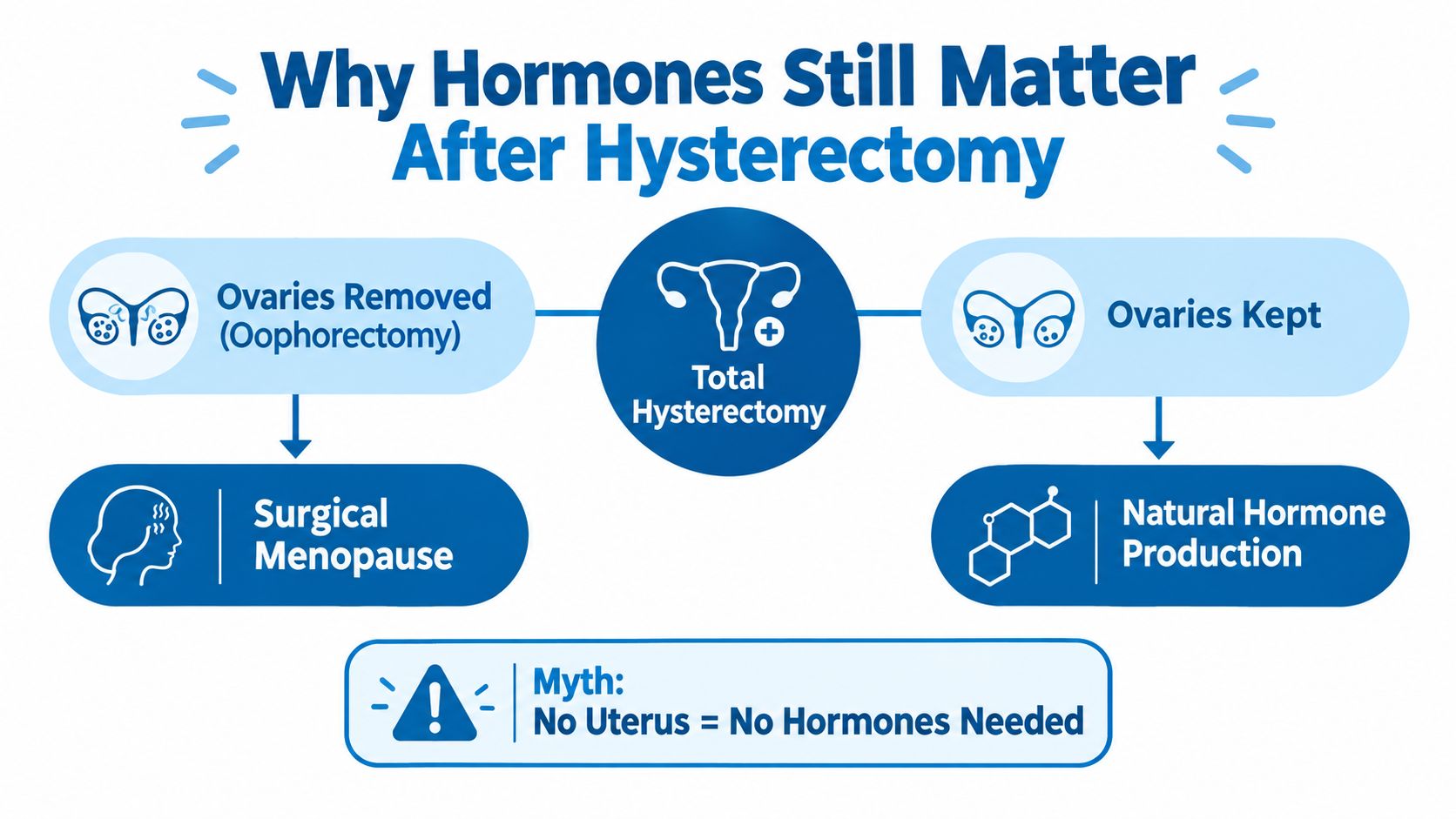
That confusion is common, and it makes sense. A hysterectomy changes one part of the reproductive system, but your hormone picture depends mostly on whether your ovaries were removed . That single detail often matters more than the word “hysterectomy” itself.
Many women do choose hormone therapy after surgery, and often stay on it long term. In one PubMed-indexed study of HRT use after hysterectomy, 83% of respondents were taking HRT at the time of the survey , and continuation remained above 84% even 10 or more years after surgery . That tells us this decision can shape comfort, sleep, and daily functioning for years, not just the first few months.
Navigating Your Health After a Hysterectomy
A patient in this stage often tells me some version of the same story. “My surgery went well, but now I don't know what's normal.” She may be having hot flashes, vaginal dryness, mood changes, or no obvious symptoms at all. She may also be wondering how surgery will affect intimacy, confidence, and relationships.
That uncertainty deserves clear answers, not guesswork.
The first thing I want patients to know is that hormone therapy after hysterectomy is an option to understand , not a rule that applies to everyone. Your body, your symptoms, your age, and your surgical details all matter. Some people need treatment quickly because their ovaries were removed and they entered surgical menopause. Others keep their ovaries and may not need hormone therapy at all.
For many women, recovery also includes questions about sexual comfort and desire. If that's on your mind, these expert insights on post-hysterectomy sexuality offer practical perspective on changes that can happen after surgery and ways to address them.
Recovery after hysterectomy isn't only about healing an incision. It's also about understanding what changed hormonally, what didn't, and what support you may need next.
If you're starting to look into hormone therapy care options, try not to let online language mislead you. “Natural” can mean very different things depending on who's using the term. In medical care, the actual question isn't whether something sounds natural. It's whether it's appropriate, evidence-based, and safe for your specific situation.
What Does Natural Hormone Therapy Actually Mean
“Natural” is one of the most confusing words in hormone care. Patients hear it and understandably think it means gentler, safer, or more like what the body used to make. Sometimes that's partly true. Sometimes it's just marketing.
The simple definition
When people talk about natural hormone therapy after hysterectomy , they may mean one of three very different things:
- Standard prescription hormone therapy
- Bioidentical hormone therapy
- Non-prescription supplements or herbs
These are not interchangeable.
A helpful way to think about hormones is a key and lock . The hormone is the key. The receptor in your body is the lock. Bioidentical hormones are designed to match the body's own hormone structure, so the key fits the lock in the expected way. That's different from saying every product labeled “natural” has the same quality, regulation, or evidence behind it.
Prescription hormones versus supplements
Prescription estrogen has solid clinical support for menopausal symptoms after surgical menopause. By contrast, public guidance discussing herbs and post-hysterectomy care notes that while many sources group BHRT with remedies such as black cohosh, red clover, and maca, the evidence for those supplements is weak or inconsistent for treating vasomotor symptoms after surgical menopause.
That doesn't mean lifestyle measures or supplements never help someone feel better. It means they should not be treated as equal substitutes for prescription estrogen when someone has significant symptoms from abrupt estrogen loss.
FDA-approved versus compounded
Another point of confusion is the difference between FDA-approved bioidentical hormones and compounded bioidentical hormones .
- FDA-approved bioidentical products are standardized prescription medications.
- Compounded products are mixed for an individual patient, usually when a specific dose or formulation is needed.
- Supplements are sold without the same role in symptom treatment as prescription estrogen.
Here's a quick comparison.
| Hormone Type | Source & Structure | Regulation | Best For |
|---|---|---|---|
| Standard prescription hormones | Prescription hormones, may or may not be bioidentical depending on product | Regulated prescription product | Patients who need established, standardized treatment |
| FDA-approved bioidentical hormones | Chemically matches human hormone structure | Regulated prescription product | Patients who want prescription treatment with bioidentical formulations |
| Compounded bioidentical hormones | Custom-mixed hormone formulation | Compounded for individual needs | Patients who need customization not available in standard products |
| Herbal supplements | Plant-based ingredients, not the same as prescription hormones | Supplement framework, not prescription hormone regulation | General wellness use, not a proven substitute for hormone therapy |
If you're comparing options, it helps to review actual estrogen therapy choices and delivery methods with a clinician rather than relying on labels alone.
Practical rule: If a product is supposed to replace estrogen after surgical menopause, ask whether it is a prescription hormone or a supplement. That question clears up a lot of confusion fast.
Assessing Your Need for Hormone Therapy
The most important question isn't “Which hormone is best?” It's “Do I need hormone therapy at all?” The answer starts with what happened to your ovaries during surgery.

If your ovaries were removed
When both ovaries are removed, your body loses its main source of estrogen abruptly. That creates surgical menopause . In that setting, estrogen therapy is commonly recommended because symptoms can come on quickly and feel intense.
A patient education overview on post-hysterectomy BHRT decisions makes this distinction clearly: when the ovaries are removed, creating surgical menopause, estrogen therapy is commonly recommended . This is the group most likely to benefit from a focused conversation about hormone therapy soon after surgery.
If your ovaries were not removed
Conflicting information often arises on this topic. If your uterus was removed but your ovaries remain, you do not automatically need hormone therapy. You may continue making hormones on your own. Some people feel stable for years. Others notice menopausal symptoms later and may decide to treat those symptoms if they become disruptive.
This decision becomes individualized. It depends on factors such as:
- Symptoms: Hot flashes, night sweats, sleep disruption, vaginal dryness, or mood changes
- Age: A younger patient with abrupt symptoms is different from someone already near natural menopause
- Health history: Clotting risk, liver disease, cancer history, and cardiovascular factors all matter
What to bring to your appointment
A good evaluation is more than “yes” or “no” to hormones. Before you meet with a clinician, write down:
- Your surgery details: Ask exactly whether one or both ovaries were removed
- Your symptom pattern: Note what happens during the day, at night, and during sex
- Your medical history: Include migraines, clotting problems, cancer history, and medications
If your clinician wants a broader picture of your metabolic and hormonal health, a wellness lab panel review can sometimes help frame the conversation alongside your symptoms and surgical history.
If your ovaries stayed, don't assume you need hormones. If your ovaries were removed, don't assume you have to suffer through symptoms without asking about treatment.
Exploring Your Hormone Therapy Options
Once the question changes from “Do I need treatment?” to “What are my options?” the conversation gets more practical. For women who no longer have a uterus, the standard hormone approach is usually simpler than many people expect.

Why estrogen-only therapy is usually favored
A major review on hormone therapy after hysterectomy found that in women without a uterus , the literature generally favors not including a progestogen unless there is a specific reason, such as residual endometriosis or risk related to endometrial tissue. The same review noted that adding a progestogen did not improve relief of hot flashes or vaginal symptoms, and was associated with a higher relative breast-cancer risk in some studies.
That surprises many patients because they've heard “estrogen and progesterone” discussed together so often. But progesterone is mainly used to protect the uterine lining. If the uterus is absent, that reason is usually gone.
Comparing common delivery methods
Different estrogen forms can suit different goals and preferences.
| Option | Administration Method | Primary Benefits | Key Considerations |
|---|---|---|---|
| Estrogen pills | Oral, systemic | Whole-body symptom relief | Goes through the digestive system and liver first |
| Estrogen patches | Transdermal, systemic | Steady delivery through the skin | Some patients notice skin irritation or patch adhesion issues |
| Estrogen gels or sprays | Topical, systemic | Flexible dosing with systemic absorption | Requires consistent application habits |
| Vaginal estrogen | Topical, local | Targets dryness and genitourinary symptoms | Not intended to treat whole-body symptoms like hot flashes |
Local relief versus whole-body relief
If your main issue is vaginal dryness , irritation, or discomfort with intimacy, local vaginal estrogen may be enough. If your main problem is hot flashes, night sweats, or sleep disruption , you may need systemic treatment instead.
Some patients also ask about herbs for sleep or anxiety when symptoms overlap. If you're curious about that side of the conversation, this overview on understanding ashwagandha for anxiety is a good example of how to look at supplement claims carefully rather than assuming “natural” always means effective.
Understanding the Safety and Benefits of HRT
Hormone therapy decisions are rarely about “good” versus “bad.” They're about matching benefits to the right patient while keeping risk in view .

What hormone therapy can help with
For women in surgical menopause, clinical guidance summarized here reports that hormone therapy can reduce hot flash frequency by about 75% . It can also help preserve bone density. That matters because abrupt estrogen loss after ovary removal doesn't just affect comfort. It can affect long-term health.
Patients often notice the earliest improvements in daily life first:
- Fewer hot flashes and night sweats
- Better sleep continuity
- Less dryness and irritation
- A more stable sense of well-being
That doesn't mean every symptom after surgery is hormonal. Fatigue, anxiety, low mood, and body changes can have multiple causes. But when symptoms began after ovary removal or track closely with estrogen loss, hormone therapy may be part of the answer.
What risks need discussion
The same guidance notes an important safety point. Oral estrogen is more strongly associated with blood-clot risk than transdermal options such as patches or creams . That's one reason route of administration matters. Two treatments may both be “estrogen,” but they don't always carry the same risk profile.
Some educational guidance also notes a window where benefit-risk balance is generally more favorable , especially for women who are under 59 and within 10 years of menopause when treatment is being considered appropriately. This doesn't mean everyone outside that window should avoid therapy. It means the conversation becomes more individualized.
Safety isn't only about whether you use hormone therapy. It's also about dose, delivery method, timing, and whether your health history changes the equation.
A short overview can help make that framework easier to picture:
How clinicians reduce risk
Good hormone therapy management usually follows a few core habits:
- Use the lowest effective dose: Enough to help symptoms, not more than needed
- Choose the right route: A patch may be preferable for someone with clotting concerns compared with an oral product
- Reassess regularly: Symptoms, side effects, and health history can change over time
That's why medical supervision matters. “Natural” doesn't remove the need for careful prescribing.
Creating Your Personalized Plan at Pause Medical
By the time many patients reach this point, they're less worried about labels and more interested in a clear next step. That's the right shift. A good plan starts with details, not assumptions.
What to prepare before your visit
Write down your surgery type, whether your ovaries were removed, and what symptoms are bothering you most. Be specific. “I don't feel right” is real, but “I wake up drenched at night, can't stay asleep, and sex has become painful” gives your clinician something concrete to work with.
Bring a short list that includes:
- Symptom timing: When did symptoms start after surgery?
- Your goals: Relief of hot flashes, better sleep, comfort with intimacy, bone health, or all of the above
- Your history: Blood clots, migraines, breast concerns, liver disease, and family history

What personalized care should look like
Good care doesn't jump straight to a one-size-fits-all prescription. It starts with a careful review of symptoms, surgical history, age, risk factors, and treatment preferences. For some patients, the answer is estrogen therapy. For others, it may be local treatment for dryness, a trial of non-hormonal support, or simple monitoring.
Medical guidance summarized by WebMD's overview of estrogen after hysterectomy notes that estrogen therapy can reduce hot flashes by about 75% and also help with sleep problems and vaginal dryness . That's why it can make such a meaningful difference when it's chosen thoughtfully.
A strong clinic experience should also include follow-up. Hormone care works best when someone checks how you're feeling, whether the dose is helping, and whether anything needs adjustment. If you want to know what that kind of oversight looks like in practice, review why patients choose this model of care.
The best treatment plan is the one that fits your surgery, your symptoms, and your risk profile. Not the one with the most appealing marketing language.
Common Questions About HRT After Hysterectomy
A few questions come up again and again after surgery, and the answers often depend on one detail patients are not always told clearly: whether the ovaries were removed. That single point changes the conversation from "Do I need hormones?" to "Would hormones help me feel better or protect my health?"
Do I always need hormone therapy after a hysterectomy
Need and benefit are not the same thing.
If your hysterectomy included removal of both ovaries, your estrogen level can drop quickly. That sudden change is called surgical menopause, and it often causes more abrupt symptoms than natural menopause. In that setting, hormone therapy is often considered because it may treat symptoms and, for some patients, support bone, heart, and sexual health.
If your ovaries were left in place, you may not need systemic hormone therapy at all. Some people continue making enough hormones for a time. Others notice symptoms later, or develop only vaginal dryness and need local treatment rather than whole-body estrogen.
Is bioidentical the same as natural
These words are often used as if they mean the same thing, but they do not.
Bioidentical hormones are prescription hormones with a molecular structure that matches the hormones your body makes. Natural is a marketing term more than a medical category. It may refer to FDA-regulated prescription products, custom-compounded hormones, herbal products, or supplements sold without proof that they treat menopause symptoms reliably. That is why asking "What exactly is in it, and how was it tested?" is so important.
Can supplements replace prescription estrogen
For significant hot flashes, night sweats, or symptoms after ovary removal, supplements are not equivalent to prescription estrogen. They work more like general wellness products than hormone replacement.
Some patients still choose to try nonprescription options for mild symptoms. That can be a reasonable discussion to have with your clinician. The key is knowing the goal. If the goal is to replace the estrogen lost after surgical menopause, supplements do not do the same job.
If I do not have a uterus, do I still need progesterone
Often, no. After hysterectomy, many patients who use systemic hormone therapy take estrogen without progesterone because there is no uterine lining to protect.
There are exceptions. A history of endometriosis, residual endometrial tissue, certain sleep concerns, or other individual factors may change the plan. This is one reason hormone prescribing after hysterectomy should not follow a template.
What if I had endometriosis or adenomyosis
That history deserves special attention. Even after hysterectomy, small areas of endometriosis can sometimes remain outside the uterus. In those cases, a clinician may choose a more individualized hormone approach and monitor symptoms closely.
Adenomyosis usually ends with removal of the uterus, but the rest of your hormone picture still matters. Ovary status, age at surgery, pain history, and current symptoms all help shape the safest option.
How long do people stay on HRT after hysterectomy
There is no single timeline. Some patients use hormone therapy for symptom relief during the early years after surgery. Others continue longer because the benefits still outweigh the risks for their situation.
A good way to think about it is like adjusting eyeglasses. The prescription should fit your current needs, not the version of you from five years ago. Regular follow-up helps your treatment stay matched to your age, symptoms, and health history.
What should I ask my doctor at my appointment
Bring these questions with you: Were my ovaries removed? Am I in surgical menopause? Are my symptoms from low estrogen, or could something else be contributing? Would local estrogen, systemic estrogen, or a nonhormonal option make the most sense for me? Do I need a prescription product, or am I considering a supplement that has not been studied the same way?
If you want more plain-language education before your visit, the Pause Medical blog on menopause and hormone questions offers additional reading.